Oil Additives and Gear Surface Finish in Aerospace Gearboxes
A geared aircraft engine asks its reduction gearbox to transmit substantial power through a compact, highly loaded mesh. The result is a tightly connected system in which tooth geometry, lubricant chemistry, surface texture, temperature, load, and manufacturing variation all influence one another. A smooth-looking flank may lower friction, yet an overly polished surface can retain less oil. A rougher finish may help form an oil film in some conditions, while increasing asperity contact and wear in others.
A Design of Experiments (DOE) study offers a disciplined way to examine those interactions. Rather than changing one factor at a time, engineers can vary the oil additive package and gear surface finish across a planned matrix, then identify which combinations affect scuffing, micropitting, efficiency, vibration, and service life. This approach is especially useful when test time, prototype parts, and representative aerospace hardware are expensive.
The work fits the wider aims of the OPTIMIZE Project, which investigates power reduction gearboxes for geared aircraft engines through simulation, tolerance analysis, physical testing, and engineering optimisation. Its relevance extends beyond lubricant selection: it helps establish how a gearbox behaves when ideal design assumptions meet production tolerances, changing operating conditions, and the practical limits of manufacturing.
For Australian aerospace organisations, the subject has a particular commercial and operational context. Suppliers around Melbourne, Adelaide, Brisbane, and Sydney may support a relatively small domestic market while relying on overseas oils, coatings, metrology equipment, or specialist gear production. Long distances between maintenance bases, humid coastal environments, and extended logistics routes make robust lubrication choices valuable from the first design review.
Why Additive Chemistry And Surface Texture Interact
An oil additive package is a carefully balanced blend rather than a single performance ingredient. Extreme-pressure agents, antiwear chemistry, friction modifiers, detergents, dispersants, antioxidants, corrosion inhibitors, and foam-control additives may all influence the contact between mating teeth. Under high pressure and flash temperatures, certain compounds react with the steel surface to form protective films. These reaction layers can prevent direct metal-to-metal contact, but their formation depends on temperature, load, sliding speed, surface energy, and the amount of fresh oil reaching the mesh.
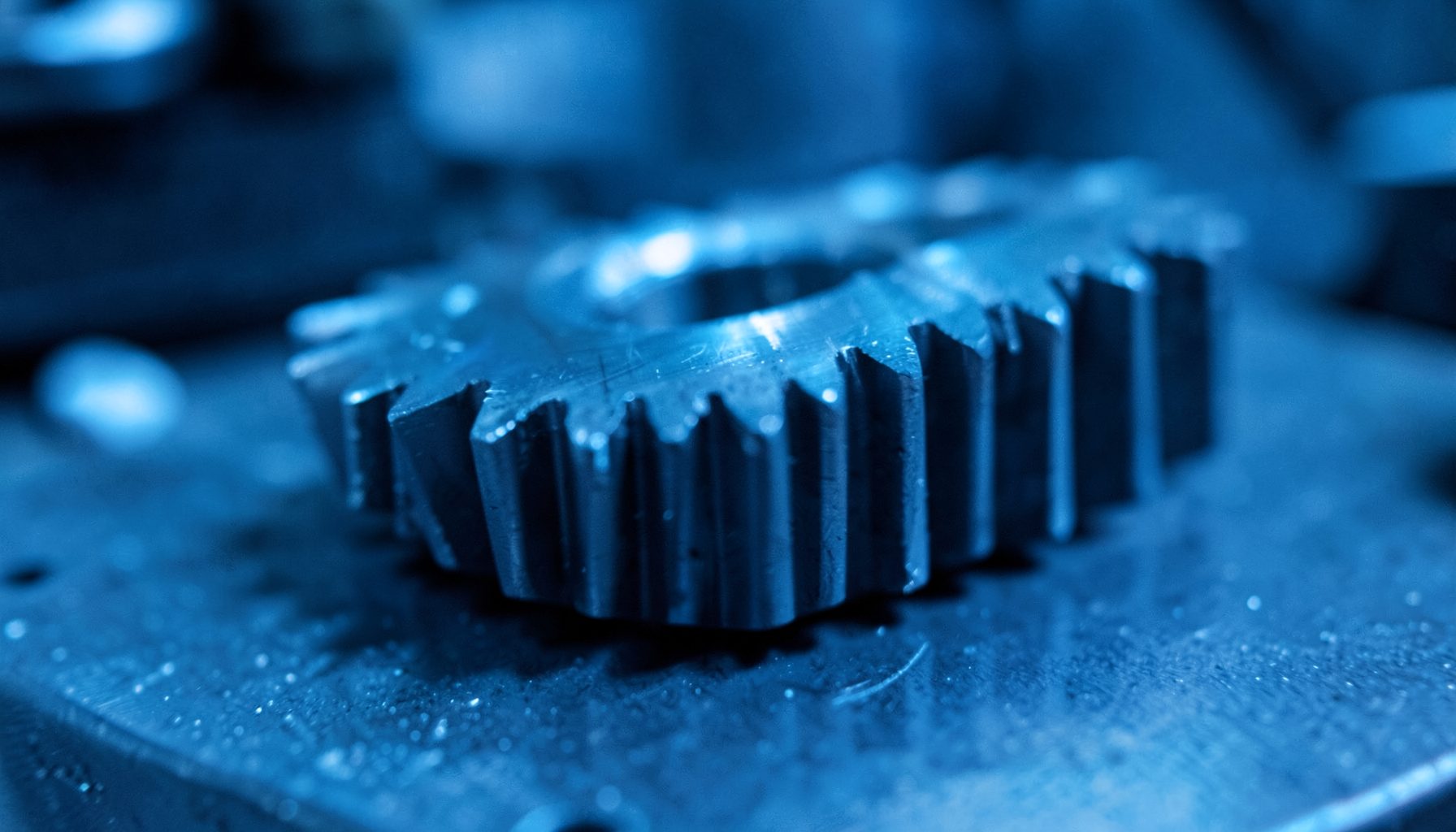
Gear surface finish changes the environment in which those reactions occur. Roughness is commonly described using parameters such as Ra, Rz, skewness, and bearing-area curves, but two surfaces with the same Ra can behave differently if their lay direction, peak distribution, or isolated valleys differ. A ground surface, superfinished surface, and honed surface may therefore respond differently to the same additive blend.
The key engineering issue is compatibility. A highly reactive additive may protect prominent asperities on a moderately finished tooth, while a smoother flank may require a different film-forming balance. Some additives can increase friction or contribute to deposits when the operating temperature is high. Others may attack coatings, seals, or bronze components elsewhere in the gearbox. The DOE must therefore study the oil and finish as a combined tribological system.
Useful test records should capture the full operating history, including oil temperature, inlet pressure, mesh load, speed, slide-to-roll ratio, churning losses, and filter condition. A structured log has practical value here, sharing some of the benefits of journaling because consistent observations often reveal patterns that isolated measurements miss.
Building A Useful DOE Matrix
The first step is to define the response variables that matter to an aircraft gearbox. Efficiency may be measured through input and output torque, while durability may be assessed through micropitting area, scuffing onset, wear volume, tooth temperature, vibration, and post-test surface chemistry. Oil degradation, deposit formation, filter debris, and changes in viscosity or acid number can provide additional evidence about how the package behaves over time.
Factors should be selected with the intended operating envelope in mind. A practical study could compare three surface conditions, such as conventionally ground, finely ground, and superfinished tooth flanks, alongside several additive-package formulations or concentration levels. Load, speed, oil temperature, and supply rate could be incorporated as continuous factors. If test capacity is limited, a fractional factorial design, response-surface method, or definitive screening design can identify dominant effects before more detailed confirmation trials.
Replicates and centre points are important. Without repeated tests, an apparent difference between two oils may simply reflect part-to-part variation, test rig drift, or measurement uncertainty. Centre points help reveal curvature, while randomising test order reduces the risk that a gradual change in rig condition is mistaken for a chemistry effect. Blocking can separate batches of gears, oil deliveries, operators, or test dates.
The study should also account for hyperstatic gearbox behaviour. Multiple tooth pairs or bearing supports may share load unevenly, making one flank experience a different local stress history from another. A test coupon with a simplified contact may be useful for screening, but full-scale or representative component tests are needed to confirm whether a favourable laboratory result transfers to the actual reduction gearbox.
Connecting Simulation With Physical Testing
Simulation can reduce the number of costly tests, provided its assumptions are visible and checked. Contact analysis can estimate Hertzian pressure, flash temperature, elastohydrodynamic film thickness, sliding velocity, and load sharing. Computational fluid dynamics or specialised lubrication models can examine oil delivery, churning, windage, and the risk of starvation near high-speed meshes.
Surface measurements should feed into those models rather than being reduced to a single roughness number. Three-dimensional profilometry can describe peak density, wavelength, directionality, and material ratio. These measurements can then support realistic friction and film-thickness estimates. If a superfinished flank has lower friction but reduced oil retention, the model should be capable of representing both effects.
Physical testing remains essential because additive chemistry can produce behaviour that is difficult to predict from bulk oil properties. A formulation may show a favourable coefficient of friction in a bench test but perform poorly after thermal ageing, contamination, or exposure to a particular coating. Gear teeth should be inspected before and after testing using microscopy, profilometry, replica techniques, and, where appropriate, surface chemical analysis.
The project documentation provides a useful reference point for understanding how engineering methods, simulation, tolerance assessment, and experimental evidence can be brought together. For a DOE on lubricant and finish interaction, that joined-up process helps prevent the common mistake of treating oil selection, gear manufacture, and gearbox architecture as separate decisions.
Managing Manufacturing And Supply Variation
A surface specification is meaningful only when it can be achieved repeatedly. Grinding wheel condition, dressing practice, heat treatment, distortion, machine alignment, and inspection method can all shift the final tooth texture. If a DOE uses carefully prepared laboratory gears while production parts show a wider distribution, the measured additive benefit may disappear in service.
Tolerance analysis should therefore be built into the test plan. Record gear lead and profile deviations, hardness, case depth, residual stress, pitch variation, and surface texture for every test specimen. Classifying parts into realistic manufacturing bands can show whether a lubricant formulation is robust or works only with an unusually narrow finish range.
Oil supply presents a similar concern in Australia. Specialist aerospace lubricants may arrive through international distributors, and a remote operator may need to hold stock for longer than a European facility would. Storage temperature, container age, moisture ingress, decanting practice, and cross-contamination can change performance before the oil reaches the gearbox. A formulation that is excellent in a controlled laboratory may be less attractive if its supply chain is fragile or its handling requirements are difficult to maintain.
Procurement teams also need a reliable way to assess supporting measurement hardware and workshop equipment. When sourcing sensors, data-acquisition units, or inspection electronics through secondary channels, engineers can apply the same careful checks recommended in refurbished electronics guidance: verify condition, provenance, calibration status, warranty, and compatibility before accepting data from the equipment.
Turning Results Into A Gearbox Decision
The outcome should be a decision model rather than a simple ranking of oils. A formulation that reduces friction may increase wear protection, while another may improve scuffing resistance at the cost of churning loss. The best choice depends on mission duty cycle, thermal margin, overhaul interval, component materials, mass targets, and the acceptable level of manufacturing variation.
Statistical analysis should distinguish main effects from interactions. An oil package may have little effect on efficiency with a conventional ground finish but deliver a meaningful improvement with a superfinished flank. Conversely, a highly polished surface may expose weaknesses in a package that relies on asperity reaction. Interaction plots, confidence intervals, analysis of variance, and response-surface maps can make these trade-offs clear to designers and certification teams.
Validation should include conditions that are likely to expose failure mechanisms: high-speed operation, low oil flow, hot soak, repeated load changes, contaminated oil, and extended endurance. Australian operating environments may add practical concerns, such as humid coastal storage near Brisbane, dust exposure during regional operations, or long transit times between Perth and eastern-state maintenance facilities. These are not substitutes for formal qualification conditions, but they can guide robustness testing and maintenance planning.
Oil removal is equally important. A lubricant that performs well at the tooth contact can still cause trouble if the scavenge system allows pooling, aeration, or excessive temperature. The discussion of oil scavenge design is directly relevant because additive performance depends on delivering the right quantity of clean, cooled oil and removing it before churning losses or local heating become dominant.
A mature result might specify a preferred additive family, an allowable surface-finish range, inspection limits, oil cleanliness requirements, and a contingency formulation. It could also identify combinations to avoid, such as a particular additive chemistry paired with a finish that encourages deposits or inadequate film formation. Those outputs can flow into drawings, supplier quality plans, maintenance instructions, and future gearbox designs.
A well-designed DOE makes the relationship between lubricant chemistry and gear surface finish measurable, repeatable, and useful for engineering decisions. By combining tribology, statistical design, metrology, simulation, and physical endurance testing, aerospace teams can improve power density without treating efficiency and durability as competing guesses. The result is a stronger basis for selecting oils and manufacturing processes that remain dependable across real production and operating variation.
Explore the OPTIMIZE Project’s research, methods, and technical resources, then use its evidence-led approach to shape your own gearbox development programme. Engage tribologists, gear manufacturers, lubricant suppliers, test engineers, and Australian operators early so that the final specification reflects both laboratory performance and service reality.