Gear tooth flank modification and the dynamics of mesh excitation
Geared turbofan engines demand gearboxes that operate reliably at rotational speeds well beyond those found in conventional industrial drives. Within these units, the periodic fluctuation of contact stiffness along the line of action — known as mesh stiffness excitation — is one of the principal sources of vibration and airborne noise. As power density targets push contact pressures higher and tooth counts lower, designers find themselves wrestling with the narrow band of dynamic behaviour that separates a smooth power transmission from one that resonates audibly in the cabin or fatigues bearings prematurely. Within the broader pursuit of cleaner, quieter propulsion, the deliberate reshaping of the gear tooth flank has emerged as a refined lever for tuning this excitation to acceptable levels.
The OPTIMIZE Project, an initiative hosted online, was established precisely to interrogate such trade-offs in a systematic, evidence-driven way. By linking design-of-experiments methodologies with high-fidelity simulation and physical rig testing, the consortium seeks to map how small, deliberate deviations from the textbook involute profile influence the dynamic response of an aerospace gear mesh. Understanding these relationships is no longer a niche academic activity; it informs the next generation of power reduction gearboxes, where every gram of material removed, every decibel quieted, and every percentage of efficiency gained contributes to the broader goals of sustainable flight.
The nature of mesh stiffness excitation
When two gear teeth enter and exit their conjugate engagement, the number of pairs in contact and the position of the load zone along the line of action continuously change. This produces a time-varying stiffness that fluctuates with each tooth pass frequency, and the resulting forcing function contains a rich harmonic spectrum centred on the gear-meshing frequency and its multiples. For spur gears, the variation is particularly abrupt, while helical configurations smooth the transition because several tooth pairs share the load at any given instant. Even so, the dynamic amplification factor can climb above 1.5 under torque transients, rattling the gears and propagating structure-borne sound through the gearbox housing, the accessory gearbox, and ultimately into the aircraft pylon and wing.
Researchers at the University of Melbourne's mechanical engineering group have observed that Australian operating conditions can amplify these effects in ways that laboratory benchmarks do not always capture. Aircraft operating out of coastal airfields like Williamtown or Pearce are exposed to salt-laden atmospheres that accelerate surface wear, while outback routings through places such as Alice Springs or Mount Isa subject gearboxes to dust ingestion and sustained thermal cycling. These local realities mean that the excitation behaviour observed on a clean test rig in a temperate-climate lab is not always equivalent to the excitation observed on the tarmac after a long, hot sector. The principal factors that shape this variation in aerospace gears include:
- Tooth geometry parameters such as pressure angle, helix angle, profile shift, and base circle radius
- Operating contact ratio, which determines whether the mesh is single, double, or fractionally loaded
- Applied load conditions, including steady torque level, dynamic amplification, and surrounding structural stiffness
- Surface condition after manufacture and during service, including roughness, residual stress, and run-in wear
- Lubricant regime, where film thickness and additive chemistry alter both contact stiffness and damping
Flank modification strategies
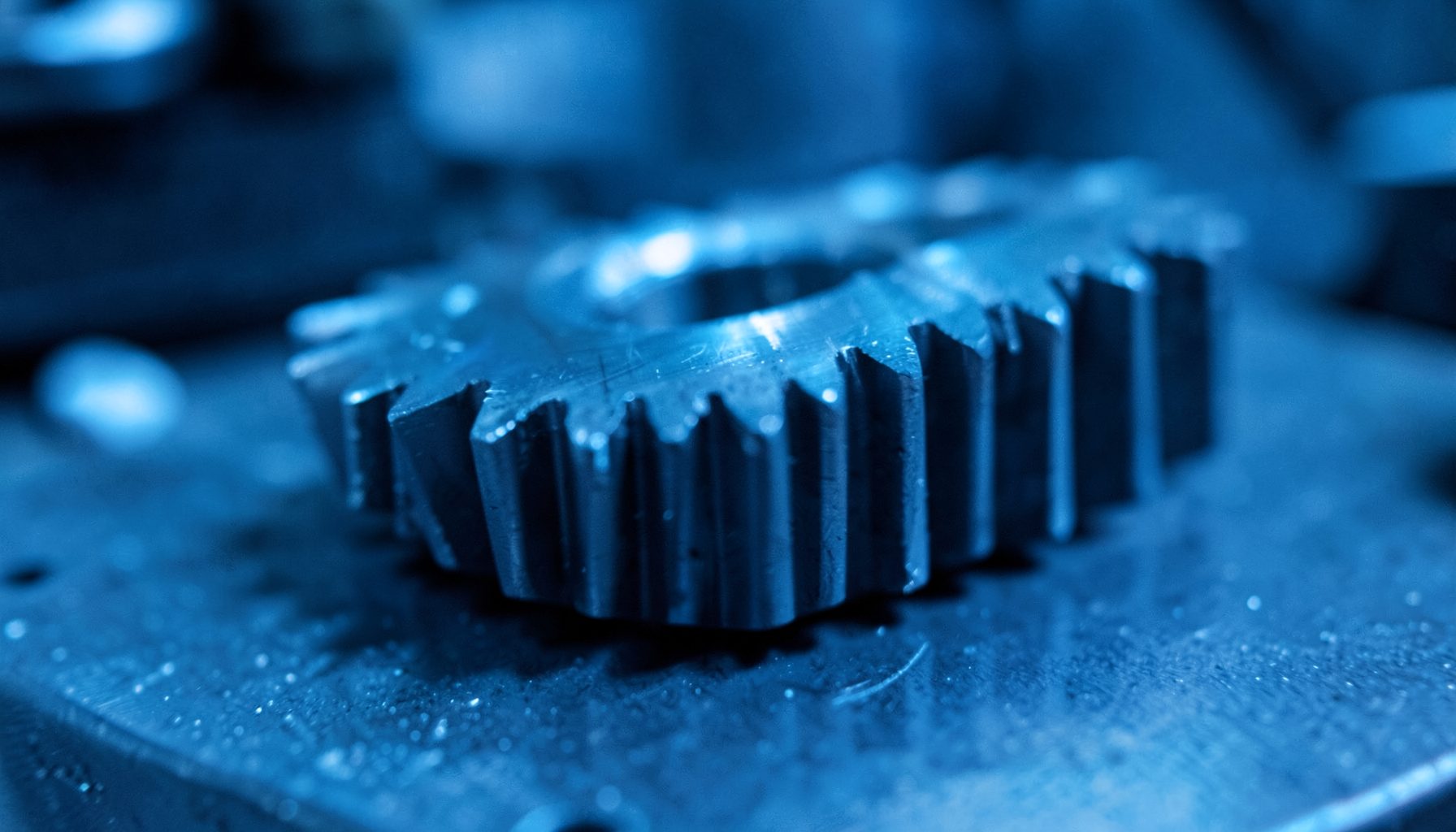
Because pure involute profiles generate the very stiffness ripple that excites vibration, engineers routinely depart from them in controlled ways. Profile relief along the flank — applied near the tooth tip or root, or distributed along a lead-crow pattern — reduces the sudden load pick-up and drop-off as teeth enter and leave mesh. The principal families of modification include tip relief, root relief, lead crowning, end relief, and combinations tailored to minimise transmission error at the dominant operating torque. Each is parameterised by amount, length, and shape, and the combination chosen shifts both the static load distribution and the dynamic stiffness curve.
The aim of these adjustments is not to flatten the stiffness curve entirely — that would be impossible without losing load capacity — but to attenuate the higher-order harmonics that couple with structural modes of the gear, shaft, and bearing system. The main flank modification approaches considered in modern aerospace gearbox design include:
- Tip relief, which shifts the load away from the vulnerable tooth tip and reduces the risk of edge contact at light load
- Root relief, which avoids the sharp stiffness rise as contact migrates toward the dedendum
- Lead crowning, which distributes load across the face width and compensates for shaft deflection and misalignment under high torque
- End relief at the tooth tip and root, which limits edge loading during transient torque reversals
- Combined tip and lead modification, used when both light-load quietness and heavy-load durability must be addressed simultaneously
Simulation and design of experiments
Computational methods for predicting the dynamic response of a modified gear mesh have matured considerably. Modern codes combine semi-analytical approaches for the contact mechanics with full finite-element tooth representations, allowing engineers to sweep a wide envelope of modification parameters in hours rather than the days an experimental matrix would consume. Within the OPTIMIZE framework, these runs are organised through structured design-of-experiments plans that capture the interactions between modification amount, profile length, helix angle correction, and tooth thinning — typically using Latin hypercube or optimal space-filling designs that are well suited to the high-dimensional, nonlinear response surfaces encountered in practice.
Such studies rely on a robust reference dataset, and the project's reference documentation portal consolidates the modelling assumptions, mesh conventions, and validation references used across the consortium. Drawing on this shared baseline, researchers can compare their results against common benchmarks and trace discrepancies back to specific modelling choices. Local collaborators, including teams at Monash University and CSIRO's digital research arm, have contributed sensitivity studies that highlight which flank parameters dominate the mesh stiffness spectrum under aerospace loading.
Trade-offs between quietness and load carrying capacity
Reducing mesh stiffness excitation through flank modification carries a familiar engineering penalty: the same relief that softens the engagement and quietens the transmission also reduces the effective load-carrying width of the tooth. If the relief is too aggressive, contact stresses concentrate and durability suffers; if it is too timid, the original vibration problem persists. Designers therefore seek an optimum that balances Hertzian contact stress, bending fatigue, scuffing risk, and acoustic excitation.
This trade-off space is shaped strongly by the lubrication regime. Modern aerospace gearboxes use low-viscosity, highly additive-loaded synthetic oils to minimise churning losses, and these fluids tolerate thinner elastohydrodynamic films than the heavier mineral oils of legacy systems. Under such conditions, any local concentration of contact stress becomes a more immediate threat to surface integrity, and the modification geometry must be carefully tuned so that the peak stiffness reduction is achieved without inviting micropitting. Australian aerospace operators have reason to care: the country's CASA-regulated maintenance intervals and the long over-water sectors flown by carriers such as Qantas demand gearboxes that survive both the design mission and extended operational margins.
Manufacturing variation and tolerance sensitivity
Even the best-designed modification is only as good as the process that produces it. Grinding, skiving, and form-grinding of case-hardened aerospace gears each introduce their own characteristic deviations from the nominal profile, and these deviations superimpose themselves on the intended relief. The result is a real gear that behaves slightly differently from its digital twin, with consequences for stiffness excitation that can be amplified in hyperstatic arrangements where multiple planet gears share the load around a sun gear.
Tolerance analysis, performed either analytically or through Monte Carlo simulation of the manufacturing distribution, allows designers to predict the spread of mesh stiffness variation across a production batch. By tying these predictions back to the dynamic model, engineers can quantify the percentage of components that will fall within acceptable acoustic limits and identify which manufacturing processes should be tightened first. The approach is especially important for power reduction gearboxes built in low to medium volumes, where a small batch of outliers can drive disproportionate warranty exposure. Australian machining specialists working on turbine engine components have built particular expertise in statistical process control of gear geometry, recognising that the country's relative distance from major OEM plants places a premium on first-time-right production.
Validation through physical testing
Simulation alone never suffices for safety-critical rotating machinery. The OPTIMIZE consortium complements its numerical work with a programme of bench testing, using back-to-back gear rigs and purpose-built spin stands to measure mesh stiffness directly through strain gauges, deflection transducers, and encoder-based transmission error systems. Acoustic measurements, performed with microphone arrays in semi-anechoic environments, complement the structural data and provide the clearest picture of how modifications actually change the radiated noise spectrum.
Beyond dedicated rigs, telemetry from in-service engines continues to refine understanding. Vibration sensors mounted at the gearbox case, accelerometers near the bearing housings, and oil-debris monitors each contribute streams of data that, when correlated with known flight segments, reveal how excitation behaviour evolves with age, contamination, and thermal history. Australia's diverse operations — from short-hop regional turboprops on routes such as Sydney–Canberra to long-range narrow-body sectors crossing the Indian Ocean — provide a particularly broad range of duty cycles that researchers mine when characterising the long-term behaviour of modified gears.
For aerospace validation, these rigs are scaled up to represent the full planetary section of a power reduction gearbox, and increasingly, prototype units are run under altitude-chamber conditions that simulate cold-soak followed by sudden high-power application. Findings from such tests have informed updates to the consortium's simulation guidelines, and the published case studies — including an interesting parallel drawn in this slot blog post about how random outcomes can still be steered toward a desired distribution — illustrate the kinds of structured statistical thinking that benefit both engineering analysis and gaming mathematics.
Bringing these threads together — analytical modelling, simulation, statistical design of experiments, and physical validation — the project has begun to assemble practical guidance for engineers specifying flank modifications in next-generation aerospace gearboxes. The work continues to evolve as materials, lubricants, and manufacturing processes develop, and the results carry implications well beyond the aerospace sector itself. Anyone interested in following the technical programme, accessing the underlying data, or engaging with the consortium is invited to explore the published case studies through the consortium's main portal.