Tribological Benefits of Diamond-Like Carbon Coatings on Gear Flanks
Geared aircraft engines place demanding requirements on the surfaces that transmit torque. Gear flanks must carry high contact loads, withstand repeated sliding and rolling, and maintain reliable lubrication while operating at elevated speeds. Small losses at the tooth interface can become significant when they are multiplied across many gear meshes and thousands of flight cycles.
Diamond-like carbon (DLC) coatings have attracted attention because they can alter the tribological behavior of steel surfaces without requiring a complete change in the underlying gear material. Their low friction, high hardness, and resistance to adhesive wear may help reduce mesh losses and protect tooth flanks during periods when the lubricant film becomes thin.
A study on the tribological benefits of diamond-like carbon coatings on gear flanks therefore needs to examine more than a simple friction coefficient. Coating adhesion, surface preparation, roughness, thermal stability, contact fatigue, lubricant compatibility, and manufacturing tolerances all influence whether a laboratory benefit can become a dependable aerospace gearbox advantage. This systems view aligns with the OPTIMIZE Project’s focus on combining simulation, design of experiments, tolerance analysis, and physical testing.
Why Gear Flanks Need Tribological Protection
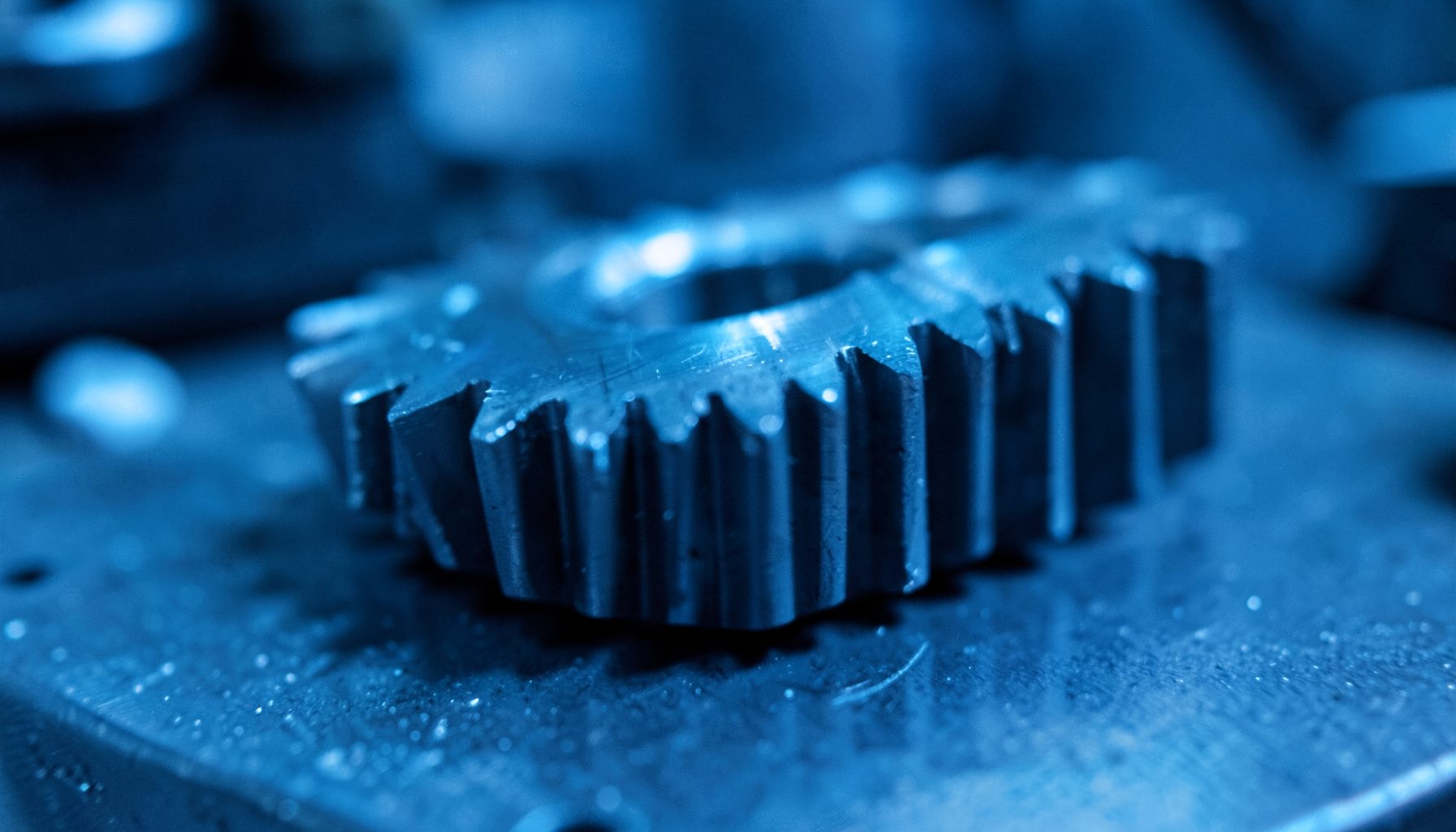
A gear mesh combines rolling contact with sliding contact. Near the pitch point, sliding velocity is relatively low, while larger sliding develops toward the addendum and dedendum regions. This relative motion generates frictional heat and can promote scuffing, micropitting, polishing wear, and lubricant degradation. The severity depends on torque, speed, oil viscosity, surface finish, tooth geometry, load distribution, and transient operating conditions.
High-speed geared aircraft engines intensify these interactions. A power reduction gearbox must transmit substantial power through compact components, which raises power density and contact stress. The teeth may also experience rapid changes in load during acceleration, deceleration, or propeller operating transitions. If the separating lubricant film becomes too thin, direct asperity interaction can begin even when the nominal design remains within an acceptable elastohydrodynamic lubrication regime.
Tooth geometry is part of the solution. Reducing unnecessary sliding can lower frictional power loss, and the OPTIMIZE discussion of profile shift effects shows why gear geometry must be considered alongside material and surface engineering. A DLC layer may further reduce the severity of the remaining sliding, but it cannot compensate for poor load distribution, unsuitable alignment, or inadequate lubrication.
How DLC Coatings Modify Contact Behavior
DLC describes a family of carbon-based coatings containing different proportions of sp2-bonded and sp3-bonded carbon, often with hydrogen or metallic dopants. Their properties vary substantially with deposition method and composition. Some films are optimized for very low friction, while others emphasize hardness, toughness, thermal stability, or compatibility with a particular lubricant.
On a gear flank, a well-designed DLC coating can reduce the shear strength of the sliding interface. Lower interfacial shear generally means less frictional torque and lower flash temperature at asperity contacts. The hard carbon-rich surface can also resist abrasive and adhesive wear, preserving the flank finish that supports an effective lubricant film.
The benefit is especially relevant during boundary or mixed lubrication, when the oil film is too thin to separate opposing surfaces completely. In full-film lubrication, the oil carries most of the load and the coating may contribute modestly to friction reduction. During start-up, shutdown, low-temperature operation, transient overload, or local misalignment, however, the coating may provide a protective tribofilm or sacrificial low-shear interface.
DLC is not automatically beneficial under every condition. A coating that is too brittle may crack under repeated Hertzian loading. Excessive thickness can alter tooth geometry and create residual stress. Poor adhesion can cause delamination, while an unsuitable surface texture can increase local asperity pressure. The coating system must therefore be engineered as a combination of substrate, interlayer, deposition process, finishing method, and lubricant.
Evidence That Requires More Than a Friction Test
A pin-on-disc test can provide useful screening data, but it does not reproduce the kinematics and stress state of a loaded aerospace gear mesh. Gear teeth experience curved contact, changing sliding direction, rolling velocity, tooth-root and tooth-tip transitions, and cyclic subsurface stress. A meaningful evaluation should progressively move from material coupons to twin-disc testing, gear-scuffing rigs, micropitting tests, and representative gearbox demonstrations.
Important measurements include coefficient of friction, wear depth, coating adhesion, surface roughness, temperature, debris generation, and changes in lubricant chemistry. Tests should cover boundary, mixed, and elastohydrodynamic regimes rather than a single selected condition. Speed, load, oil temperature, additive package, surface finish, and running-in history should be recorded because each can change the observed result.
Rolling contact fatigue deserves particular attention. A hard coating may protect the surface while transferring stress into the substrate or coating-substrate interface. Repeated cycles can initiate cracks below the surface, at coating defects, or near a roughness peak. Research into material cleanliness and fatigue is relevant here because inclusions and metallurgical imperfections can remain critical even when a DLC layer improves surface friction and wear.
The most useful experimental programs combine controlled factors with statistical design of experiments. Coating thickness, carbon structure, substrate hardness, roughness, oil formulation, load, speed, and temperature can be varied systematically. This approach helps identify interactions, such as a coating that performs well on a polished flank but loses its advantage when manufacturing variation increases roughness or misalignment.
| Evaluation aspect | Potential DLC contribution | Main risk or limitation | Suitable verification |
|---|---|---|---|
| Sliding friction | Lower interfacial shear and reduced mesh loss | Benefit can depend strongly on oil chemistry and temperature | Twin-disc and gear-efficiency tests |
| Scuffing resistance | Greater protection during thin-film operation | Adhesion failure may expose the substrate | Controlled scuffing-rig trials |
| Micropitting and wear | Hard, low-shear surface can preserve flank finish | Coating defects or residual stress may initiate damage | Extended rolling-sliding fatigue tests |
| Thermal behavior | Lower friction can reduce flash temperature | Deposition or lubricant limits may restrict high-temperature use | Thermally instrumented gear tests |
| Manufacturing robustness | Surface treatment may compensate for moderate variation | Roughness, edge effects, and thickness variation remain important | Tolerance-based DOE and inspection |
| Gearbox integration | Possible efficiency and durability improvement | Compatibility with seals, debris control, and repair processes | Full-system endurance demonstration |
Interaction With Gear Geometry And Deflection
A coating changes the behavior of the tooth surface, but it does not remove the mechanical causes of uneven contact. Tooth modifications, profile corrections, lead crowning, and alignment strategy determine how load moves across the flank. Under torque and temperature, shafts, bearings, housings, and gears deform. Those deflections can shift the contact pattern away from the intended design position.
This is why thermal and mechanical deflections should be considered when assessing a coated gear. A DLC layer may reduce friction in a properly loaded zone, yet a local overload caused by deflection can raise contact stress beyond the coating’s practical capacity. Conversely, a coating could make a finely optimized flank more tolerant of brief boundary-lubrication events.
The coating’s thickness also matters geometrically. Although DLC films are usually thin compared with conventional gear modifications, the deposited layer must be uniform across the working flank and tooth edges. Edge rounding, masking, fixture orientation, and deposition shadowing can produce local property changes. Post-coating superfinishing may improve roughness, but it must not strip the film or create a weak transition at the edge of the contact zone.
Hyperstatic gear systems introduce another concern. When several tooth pairs or parallel paths share load, small dimensional deviations can change how force is distributed. A surface treatment may reduce frictional sensitivity at one contact while a neighboring contact carries more load than expected. Tolerance analysis and multibody or loaded-tooth-contact simulation can help determine whether the coating produces a robust benefit across the full range of gear geometry and assembly variation.
Lubrication And Thermal Compatibility
DLC performance depends on the interface created by the coating, lubricant, and surrounding atmosphere. Aviation gearbox oils contain additives designed to control wear, oxidation, corrosion, and scuffing. Some additives form protective films on ferrous surfaces, while others may interact differently with carbon-based coatings. A coating that performs well in a simple base oil may behave differently in a fully formulated lubricant.
Temperature changes viscosity and film thickness, which in turn changes the portion of the load carried by the oil versus the solid surfaces. At high speed, churning and windage can add heat, while restricted oil flow can create local hot spots. Lower friction from DLC may reduce one part of the thermal load, but the coating must remain stable at the actual contact temperature and must not accelerate oil degradation or generate harmful particles.
Lubricant supply also matters in compact gearboxes. Jet impingement, oil jets, scavenge systems, and housing geometry determine whether fresh lubricant reaches the mesh. If coating debris or wear particles enter bearings or other gear contacts, a local flank advantage could create a system-level reliability problem. Filtration, debris monitoring, and post-test surface analysis should therefore be included in any endurance campaign.
Testing should cover the expected thermal envelope, including cold starts and high-temperature steady operation. It should also include realistic oil aging and contamination conditions where practical. The goal is to identify a stable tribofilm and predictable wear mechanism, rather than relying on a short test performed under ideal laboratory conditions.
Manufacturing, Inspection, And Certification Considerations
Applying DLC to production gears requires a repeatable process. Substrate cleanliness, heat treatment, grinding damage, residual stress, and surface waviness all influence adhesion and contact performance. Before deposition, manufacturers may need to control polishing or superfinishing more tightly than they would for an uncoated gear. Cleaning processes must remove residues without damaging the tooth geometry.
Inspection can combine coating-thickness measurement, adhesion testing, microscopy, roughness mapping, and nondestructive evaluation. Because gear flanks are curved and difficult to access, a qualification method must demonstrate that measurements taken on witness coupons represent the actual component. Process controls should track deposition parameters, fixture position, chamber condition, and batch-to-batch variation.
Repair and life-cycle management also deserve attention. Aerospace gearboxes may require overhaul, blending of minor damage, recoating, or replacement of individual components. The coating system should have a defined response to rework, and engineers need criteria for distinguishing acceptable wear from a condition that threatens fatigue life. Traceability is essential when a surface treatment becomes part of the certified design rather than an optional enhancement.
A balanced qualification plan should compare coated and uncoated gears using the same geometry, material, heat treatment, lubricant, and loading history. It should measure efficiency, temperature, wear, micropitting, scuffing, and fatigue rather than relying on a single headline metric. The resulting evidence can feed the OPTIMIZE methodology, linking material selection and surface treatment to gearbox-level efficiency, durability, weight, and power-density targets.
Priorities For A Robust Development Program
- Define the target failure modes first, distinguishing friction loss, scuffing, micropitting, abrasive wear, and rolling contact fatigue.
- Select coating composition and thickness together with the gear steel, heat treatment, finishing process, and aviation lubricant.
- Use design-of-experiments methods to expose interactions among load, speed, temperature, roughness, alignment, and coating parameters.
- Combine loaded-contact simulation with tolerance analysis so that coating performance is tested under realistic deflection and manufacturing variation.
- Establish component, subsystem, and full-gearbox tests with inspection criteria that support repeatable aerospace qualification.
The strongest case for DLC will come from measured system benefits: lower churning or mesh losses, reduced flank temperature, longer fatigue life, and stable performance after endurance testing. A low friction coefficient by itself is insufficient if the film delaminates, changes the load path, or loses compatibility with the gearbox oil.
For the OPTIMIZE community, this subject offers a practical connection between surface engineering and power reduction gearbox design. Researchers and engineers can use the project’s methodology to compare coating concepts, prioritize the most influential variables, and identify where physical testing is needed to validate simulation. Reviewing the linked research, examining project videos, and applying a structured test matrix can help turn DLC from a promising material option into an evidence-based gearbox technology.
Explore the OPTIMIZE Project resources and use the findings to shape the next round of coated-gear simulations, experiments, and design decisions for more efficient and durable aircraft propulsion systems.