

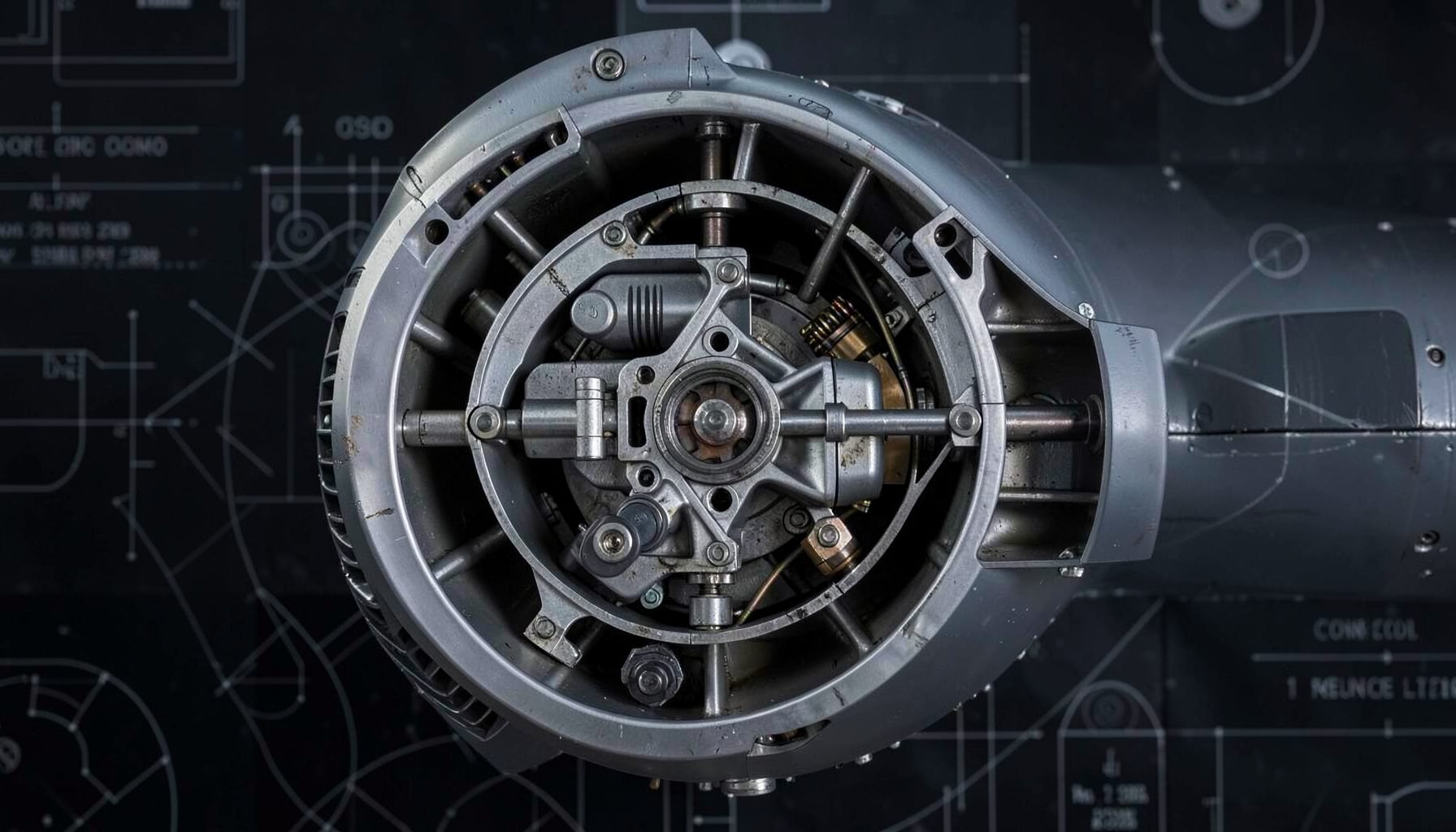
How Bearing Preload Variation Changes Planet Gear Load Sharing
In an epicyclic gearbox, several planet gears transmit torque around a central sun gear and inside a ring gear. The arrangement offers high power density and compact packaging, which makes it attractive for geared aircraft engines. Its performance, however, depends on how evenly the planets share the transmitted load. Small changes in bearing support can shift that balance significantly.
Bearing preload is one of the less visible contributors to load-sharing behaviour. It affects internal clearance, radial and axial stiffness, rolling-element contact, friction, and the position of each planet relative to the sun and ring gears. When preload differs from one planet bearing to another, the gear mesh may no longer divide torque according to the ideal symmetrical model.
This issue is especially important in aerospace reduction gearboxes, where high speed, tight mass limits, thermal gradients, manufacturing tolerances, and long service life interact. A useful assessment therefore has to combine gear-contact analysis with bearing mechanics, tolerance analysis, design-of-experiments methods, simulation, and physical testing. The broader engineering approach described by the OPTIMIZE project provides a relevant framework for studying these connected effects.
Why bearing preload matters in planetary gearboxes
Preload is an intentional internal bearing load applied so that rolling elements remain in firm contact with their raceways under operating conditions. It can be produced through interference fits, matched spacers, spring elements, controlled assembly displacement, or a prescribed axial setting. The selected value influences bearing stiffness and the resistance of the planet bearing to displacement.
A planet gear does not float in isolation. Its bearing supports the planet pin, while the carrier, sun gear, ring gear, shafts, and housing determine the available alignment. If the bearing is too flexible, the planet can move enough to change the mesh contact pattern. If it is too stiff, it may force the planet to react to geometric errors rather than accommodate them. Excessive preload can also increase friction, heat generation, power loss, and bearing fatigue.
The design target is therefore not simply “high preload” or “low preload.” It is a controlled stiffness and clearance condition that remains suitable across speed, temperature, torque, and manufacturing variation. In a geared aircraft engine, that condition must also remain compatible with lubrication flow and thermal expansion.
How load sharing develops through the mesh
In an ideal planetary train, each planet carries the same share of torque. For three identical planets, a simplified calculation may assign one-third of the total load to each planet. Real systems depart from this condition because of carrier pin-position errors, gear-tooth spacing, profile deviations, housing distortion, bearing clearance, shaft deflection, and differences in support stiffness.
The planet with the smallest effective deflection can engage the sun and ring meshes sooner or more firmly. It then attracts a larger portion of the circumferential load. The additional force increases tooth contact stress and bearing reactions, which can further alter the planet’s position. This creates a coupled relationship between gear mesh stiffness and bearing stiffness.
Preload variation changes that relationship in several ways:
- A higher preload generally raises bearing radial and tilting stiffness.
- A lower preload can permit greater planet displacement and uneven mesh contact.
- Differences in axial preload can alter the planet’s attitude if helical gears generate thrust.
- Friction changes may restrict the planet’s ability to settle into a balanced position.
- Thermal expansion can amplify or reduce the original assembly preload.
The result is a load-sharing factor above the ideal value. Designers commonly express this with a planetary load-sharing coefficient, which compares the most heavily loaded planet with the average or nominal planet load. A rising coefficient indicates that one or more planets are carrying an excessive share of torque.
The role of hyperstatic support and structural flexibility
Planetary gear trains are often hyperstatic: several load paths exist, and the number of constraints exceeds what is needed for basic static equilibrium. This improves torque capacity and compactness, but it means that force distribution is governed by stiffness and compatibility as well as by equilibrium. A small geometric error can therefore produce a large reaction change.
Bearing preload variation is particularly influential in a hyperstatic system because it changes the local compliance of one load path. If one planet bearing is stiffer than the others, that planet may resist carrier and gear displacement more strongly. The surrounding structure then redistributes force through the sun and ring meshes. The effect may be modest at low torque but become pronounced as tooth contact stiffness increases.
Carrier flexibility can either magnify or moderate the problem. A compliant carrier may allow planets to find a more balanced position, although excessive movement can introduce misalignment. A very rigid carrier can preserve positional errors and transfer them directly into the gear meshes. Ring-gear mounting, housing distortion, and bearing-seat deformation also influence how preload variation becomes tooth load variation.
For helical planetary gears, axial mechanics add another layer. Mesh thrust interacts with bearing preload, axial clearance, and the stiffness of thrust-supporting components. A change in preload can modify both the axial position and the tilt of a planet, affecting contact across the tooth face. This is why a purely two-dimensional torsional model may underestimate the impact of bearing variation.
Comparing preload conditions in analysis
A useful simulation should treat preload as a distributed manufacturing and assembly variable rather than as a single fixed design input. The table below shows the typical tendencies, though actual results depend on bearing type, geometry, lubrication, gear tooth form, and structural stiffness.
| Preload condition | Bearing and planet behaviour | Likely load-sharing effect | Main risks |
|---|---|---|---|
| Low or insufficient preload | Greater displacement, possible clearance under changing load, lower support stiffness | One planet may lose contact consistency while another attracts load | Skewed tooth contact, vibration, impact loading, reduced fatigue life |
| Nominal matched preload | Balanced support stiffness and predictable positioning | Closest approach to equal planet loading | Sensitivity to temperature and assembly accuracy remains |
| Moderate preload variation | Different radial and tilting stiffness between planets | Unequal mesh engagement and increased maximum planet load | Local tooth stress, bearing reaction imbalance |
| High uniform preload | Stiffer support with reduced internal movement | May improve positional control if thermal conditions are stable | Friction, heat, preload loss, shortened bearing life |
| High preload on one planet only | One load path becomes unusually rigid | That planet can attract a disproportionate share of torque | Severe mesh overload, accelerated bearing and gear damage |
| Thermally shifted preload | Stiffness changes during operation | Load sharing may vary with speed, torque, and temperature | Transient overload and unpredictable operating margins |
Statistical analysis can reveal whether preload variation is a dominant factor or merely a secondary contributor. A design-of-experiments study might vary bearing preload, carrier pin error, gear backlash, ring-gear stiffness, temperature, and torque together. Response measures could include maximum tooth-root stress, contact pressure, bearing load, planet load-sharing coefficient, transmission error, and power loss.
Monte Carlo tolerance analysis is valuable when preload is controlled through several dimensions, such as spacer thickness, bearing internal geometry, housing-seat position, and assembly displacement. Instead of reporting one predicted load-sharing value, the analysis can estimate a distribution and identify the percentile cases that threaten the design requirement.
Building a reliable simulation model
The model must represent the physical route by which preload affects planet position. A simple lumped stiffness model can be useful during concept development, but it should distinguish radial, axial, and tilting stiffness where those modes influence gear alignment. Bearing stiffness may also be load-dependent, especially for rolling bearings operating at high speed.
Gear contact models should include tooth compliance, backlash, profile and lead modifications, and the changing contact ratio. For a planetary train, the model should allow each planet to have its own bearing properties and geometric errors. Treating all planets as identical can conceal the very imbalance that the analysis is intended to find.
Speed and lubrication deserve special attention. Centrifugal effects, lubricant viscosity, churning, cage behaviour, and thermal growth can change bearing operating conditions. At high rotational speed, the preload measured during assembly may not represent the effective preload during flight-like operation. A coupled thermal-mechanical analysis can estimate how heat generation and temperature gradients alter bearing clearance and support stiffness.
Boundary conditions should reflect the gearbox structure rather than assuming an infinitely rigid housing. Flexible multibody dynamics, finite-element submodels, and gear-contact calculations can be connected to capture carrier deformation and ring-gear movement. The level of detail should follow a correlation plan: include the mechanisms that can be measured and validate them with targeted tests.
Validating preload effects through physical testing
Physical testing should begin with controlled component or subassembly experiments before progressing to a complete gearbox. Bearing tests can establish the relationship between assembly displacement, preload, speed, temperature, friction torque, and stiffness. Planet-pin or carrier tests can show how support deflection changes under radial, axial, and tilting loads.
A planetary rig can then compare matched and intentionally varied preload conditions. Instrumentation might include strain gauges on planet pins, torque measurement, accelerometers, thermocouples, displacement sensors, and, where practical, tooth-root or housing strain measurement. These signals help separate true load-sharing changes from effects caused by vibration, lubrication transients, or sensor bias.
Test planning should include both steady-state and transient conditions. A gearbox can show acceptable load sharing at one torque and speed but develop a different pattern during acceleration, deceleration, thermal soak, or torque reversal. Repeated tests are needed to distinguish deterministic preload effects from random assembly scatter.
Data reduction should compare measured planet reactions with model predictions using common definitions and reference points. If the model predicts a strong preload sensitivity but the rig does not, the discrepancy may indicate an incorrect bearing stiffness law, an overly rigid structural assumption, or an unrepresented contact feature. Conversely, an unexpectedly large test response may reveal housing distortion or friction effects that were omitted from the simulation.
Manufacturing variation and inspection strategy
Preload control begins with the tolerance chain. Bearing internal clearance, raceway geometry, spacer dimensions, shaft and housing fits, axial shoulders, surface finish, and assembly temperature can all contribute to the final condition. A nominal preload value is meaningful only when the process can hold the dimensions and measurement uncertainty associated with it.
Inspection should focus on the variables that most strongly influence load sharing. Statistical process control can track spacer thickness, bearing torque, axial displacement, and selected geometric features. However, bearing rolling torque alone may not fully identify radial or tilting stiffness, so it should be interpreted alongside dimensional and functional measurements.
Matched bearing sets or selective assembly may reduce planet-to-planet differences. That approach can improve consistency, but it may increase cost and complicate repair logistics. A robust design may instead accept a controlled range of preload and demonstrate through analysis and testing that the resulting load-sharing distribution remains safe.
The project’s public communication should also preserve clear information architecture. For example, engineering test evidence should be separated from unrelated web material such as a 24/7 slots resource, so readers can identify technical objectives, methods, and results without ambiguity. Clear presentation matters when complex validation evidence must support design decisions.
Practical recommendations for a robust design
A balanced engineering process can reduce sensitivity to bearing preload scatter without relying on excessive stiffness or unnecessarily tight manufacturing tolerances.
- Define preload as a tolerance distribution with temperature and speed limits, rather than as one nominal assembly value.
- Include planet-specific bearing stiffness and geometric variation in multibody and gear-contact simulations.
- Use design-of-experiments methods to rank preload against carrier error, gear modification, housing flexibility, and lubrication conditions.
- Validate the predicted load-sharing coefficient with instrumented planetary-rig tests at steady and transient operating points.
- Set inspection and acceptance limits around the parameters that most strongly affect planet alignment and support stiffness.
The key design objective is a gearbox that remains tolerant of realistic variation. A slightly less efficient nominal arrangement may provide better fleet-level performance if it avoids sharp increases in tooth stress when preload, temperature, and geometry move toward their manufacturing limits.
A further opportunity is to design the support system so that load sharing is self-correcting. Planet bearings, flexible pins, floating members, controlled gear modifications, and compliant ring-gear supports can be combined to accommodate small errors. These features must be evaluated as a system, since improving one load path can unintentionally increase sensitivity elsewhere.
Turn analysis into gearbox performance
Bearing preload variation should be treated as a system-level design parameter in every high-speed epicyclic reduction gearbox. Its effects reach from rolling-element contact and thermal behaviour to planet alignment, tooth stress, vibration, efficiency, and durability. The most credible design decisions come from linking tolerance analysis, flexible structural models, gear-contact calculations, and physical test evidence.
Use the OPTIMIZE project’s research perspective to examine your own gearbox architecture, identify the preload variables that matter most, and build a validation plan around measurable operating risks. A disciplined combination of simulation and testing can turn uncertain planet load sharing into a controllable design feature.