

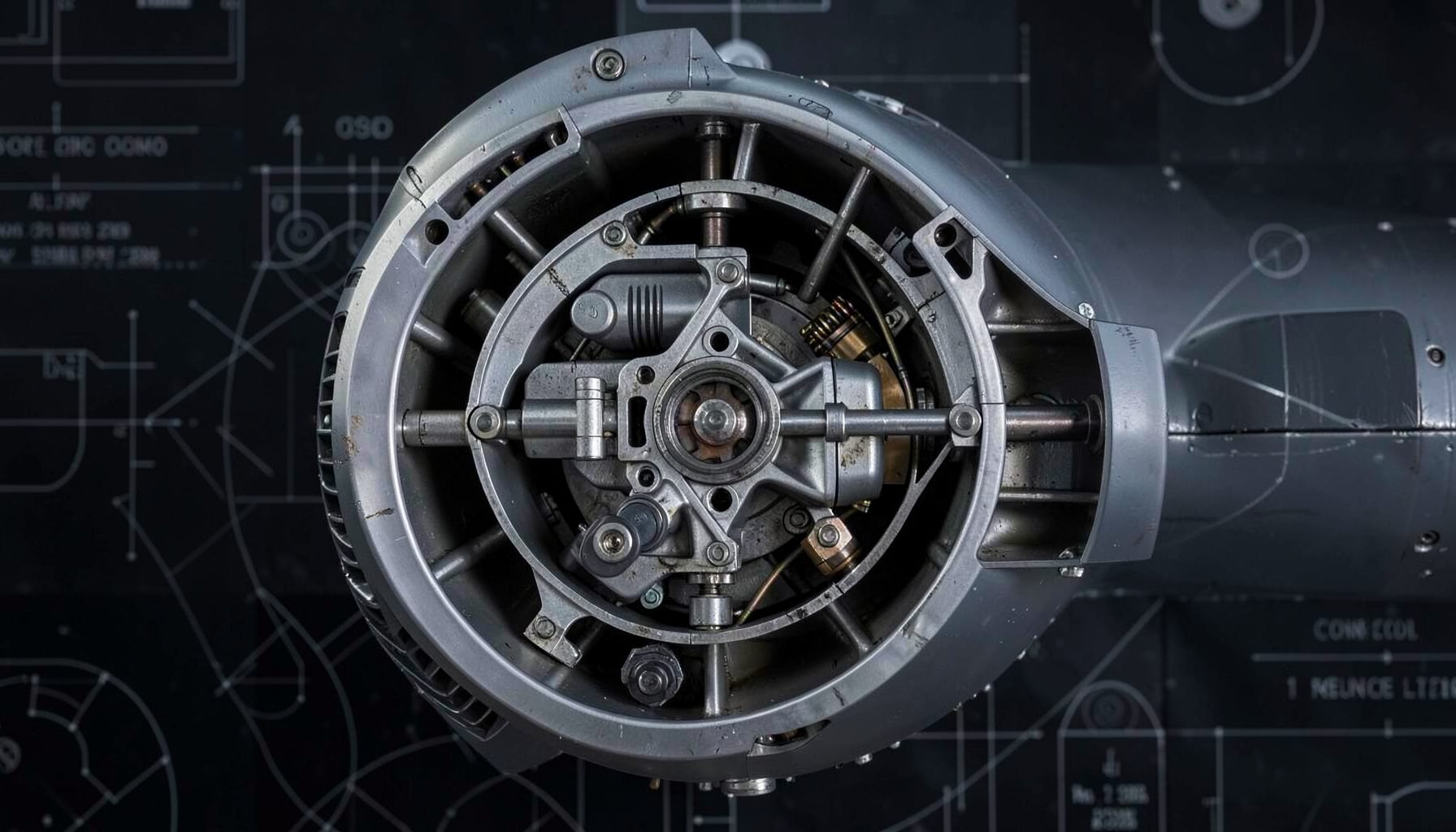
Optimizing planet count for power density in star arrangements
A geared aircraft engine must transmit substantial power through a compact, lightweight drivetrain. In that environment, the planetary gearbox is attractive because several planets can share torque around a central sun gear while the ring gear contains the mechanism within a relatively small diameter. A star arrangement takes this architecture further by using multiple planet gears whose axes remain fixed in the housing. The result can be a highly efficient, rigid, and power-dense transmission, provided the load is shared as intended.
The number of planet gears is therefore a primary design variable rather than a simple packaging choice. Adding planets may raise the theoretical torque capacity, yet it also changes tooth spacing, mesh interference, housing stiffness, lubrication access, manufacturing tolerance, and assembly sensitivity. The best configuration is the one that delivers the highest usable power density after these effects are included.
For the OPTIMIZE research approach, this question belongs to a broader engineering workflow involving design of experiments, numerical simulation, tolerance analysis, and physical testing. Planet count must be evaluated alongside gear geometry, operating speed, materials, lubrication, and load paths. A result that looks superior in an ideal computer model may lose its advantage when microscopic variations in alignment or tooth geometry are introduced.
Why planet count matters to power density
In a star planetary arrangement, each planet can carry part of the transmitted torque. If three planets share the load perfectly, the nominal force at each mesh is lower than it would be in a single-planet system. Increasing the count to four, five, or more can reduce the theoretical load per gear and may permit smaller gears for a given total torque. This is the basic reason that multiple-planet architectures are associated with high torque density.
Perfect sharing is rare in a real gearbox. Small differences in planet bearing position, tooth thickness, carrier or housing deformation, and gear runout cause some planets to attract more load than others. A useful design calculation therefore applies a load-sharing factor rather than dividing torque equally. The effective capacity may be governed by the most heavily loaded planet, not by the average value across all meshes.
Planet count also affects the amount of material surrounding each gear. More planets require more circumferential space, and the space between adjacent planets must be large enough to prevent interference and permit proper tooth engagement. If the ring gear diameter is held constant, adding planets can force smaller planet gears or a reduced tooth count. Those changes may increase bending stress, lower contact strength, or restrict the available reduction ratio.
Power density should consequently be measured as a system-level quantity. It includes transmitted power divided by gearbox mass or volume, but it should also reflect efficiency, thermal limits, service life, noise, and manufacturability. A configuration that carries more torque but requires a larger housing, heavier bearings, or complicated assembly may have a lower practical power density than a simpler arrangement.
Load sharing in a fixed-axis planetary system
Star arrangements provide a valuable structural feature: the planet axes are fixed relative to the housing. This can simplify the load path and support a stiff, compact gearbox. It can also create hyperstatic behavior because multiple mesh reactions are constrained by the same housing and ring gear. When the components are not perfectly aligned, the constraints can produce uneven forces and local contact concentrations.
The stiffness balance between the sun gear, planet pins, housing, and ring gear is central to this behavior. A very rigid housing may preserve alignment under nominal torque, but it can also transfer assembly errors directly into the gear meshes. A more compliant structure may equalize some loads through elastic deformation, while allowing excessive deflection, tooth edge loading, or loss of contact at high speed.
The sun gear and ring gear must also accommodate the selected planet count geometrically. Equal spacing is desirable for balance and dynamic behavior, but the tooth numbers must satisfy phasing and assembly conditions. Certain combinations allow all planets to mesh correctly with the sun and ring, while others introduce indexing constraints or require special assembly procedures. These conditions should be checked at the beginning of a design study rather than after the gear sizes have been selected.
Bearing arrangement is another limiting factor. Each planet needs support that can tolerate radial forces, speed, heat, and lubrication demands. More planets may distribute total torque, yet they also increase the number of bearings, seals, interfaces, and potential friction sources. In an aircraft engine gearbox, the added components must justify their mass and reliability burden.
Geometry, speed, and lubrication trade-offs
Planet count interacts directly with gear dimensions. For a fixed ring gear diameter and ratio, increasing the number of planets often reduces the available planet diameter. Smaller planets may have less tooth bending strength and less room for robust bearings. A designer can compensate with greater face width, stronger materials, optimized pressure angles, or a different module, but each solution affects mass, friction, and manufacturing cost.
High rotational speed makes these choices more demanding. Centrifugal forces act on planet gears and bearings, while dynamic mesh forces may rise if tooth errors or imbalance are present. The star arrangement can benefit from balanced circumferential placement, but balance alone does not eliminate transmission error. A greater number of meshes creates more opportunities for excitation, especially when manufacturing variation causes slightly different contact patterns.
Lubrication must be evaluated at the same time as gear strength. Additional planets increase the number of oil-entry and oil-exit regions within the gearbox. At high speed, windage and churning losses can become significant, and oil may be flung away from the most highly loaded contacts. Poorly placed jets or inadequate drainage can create local temperature increases even when the average lubricant flow appears sufficient.
Thermal behavior can determine the useful limit of planet count. A design with low nominal tooth stress may still be unsuitable if frictional losses raise oil or bearing temperatures. Computational fluid dynamics, thermal network models, and rig measurements can help identify whether a compact multi-planet arrangement maintains adequate cooling across its operating envelope. Efficiency is therefore part of the power-density calculation, rather than a separate refinement made later.
Design variables that must be tested together
A meaningful optimization should vary planet count alongside the parameters that control its consequences. These may include module, face width, pressure angle, helix angle, sun-to-ring ratio, gear material, bearing stiffness, housing thickness, lubrication flow, and allowable transmission error. Examining planet count in isolation can produce misleading rankings because the surrounding geometry may be unfairly constrained.
Design-of-experiments methods offer an efficient way to explore this space. Instead of running every possible combination, engineers can select representative cases that reveal main effects, interactions, and nonlinear trends. A response surface can then relate planet count to mass, efficiency, contact stress, bending stress, temperature, and predicted fatigue life.
Simulation should include both ideal and perturbed models. The ideal model establishes the theoretical potential of each arrangement. Perturbed models introduce realistic variations such as tooth thickness errors, planet-pin position error, ring gear ovality, bearing clearance, housing deformation, and thermal growth. Monte Carlo analysis or carefully selected tolerance cases can show how often a design reaches its target load-sharing factor.
For large parameter sweeps, cloud-based computing can run analyses in 24/7 slots, allowing engineers to compare many combinations of planet count, geometry, and tolerance assumptions without reducing the study to a few nominal cases. The useful output is not merely a single optimum, but a robust region where performance remains acceptable when manufacturing and operating conditions vary.
Comparing candidate layouts
The following comparison illustrates the typical engineering direction of the trade-offs. It is a qualitative framework rather than a substitute for gear calculations, bearing analysis, or test data.
| Planet arrangement | Torque-sharing potential | Packaging effect | Main technical risk | Likely development role |
|---|---|---|---|---|
| Three planets | Moderate to high | Generous spacing and larger planet diameter | Higher load per planet | Baseline for robust, accessible designs |
| Four planets | High | Good balance between capacity and space | Unequal load sharing from stiffness errors | Strong candidate for balanced power density |
| Five planets | Very high in theory | Tighter circumferential packaging | Smaller gears, assembly sensitivity, lubrication access | Candidate for aggressive mass reduction |
| Six or more planets | High theoretical capacity | Dense layout with restricted clearances | Mesh interference, bearing count, thermal and tolerance complexity | Specialized option requiring detailed validation |
A three-planet system often provides a useful reference because it leaves more room for larger planet gears and practical inspection. Its lower component count can simplify assembly and lubrication. However, the individual planets carry a larger share of the torque, and the system may need greater face width or gear size to achieve the desired life.
Four planets frequently offer an attractive compromise. The arrangement can provide improved nominal load distribution without making the planet gears excessively small. It also supports good rotational balance and may fit established manufacturing processes. Its performance still depends on the stiffness and tolerance behavior of the housing, pins, and ring gear.
Five or more planets can be valuable when the primary objective is minimum mass or maximum torque in a fixed envelope. Yet the theoretical advantage narrows if the extra planets cannot share load effectively. The design may require tighter tolerances, more precise bearing control, advanced lubrication delivery, and specialized assembly tooling. The optimum is often found where the marginal torque benefit from an additional planet equals the added penalty in complexity and mass.
From simulation to physical validation
Analytical gear-rating methods are essential for initial sizing, but they cannot fully capture the coupled behavior of a high-speed star arrangement. Finite element models can estimate housing and ring gear deformation, while multibody simulations can examine mesh forces, bearing reactions, and dynamic behavior. Contact analysis can reveal whether a planet is carrying a disproportionate load because of local alignment error.
The model should be calibrated against physical evidence. A representative gearbox or subscale rig can measure torque distribution, tooth contact patterns, temperature, vibration, efficiency, and oil behavior. Strain gauges, instrumented planet pins, or indirect reaction measurements may help determine whether the simulated load-sharing factor is realistic. Testing should cover multiple torque and speed points rather than a single nominal condition.
Tolerance analysis becomes especially important when the arrangement is hyperstatic. The test article should include realistic manufacturing variation, not a hand-selected assembly with unusually precise components. Comparing several builds helps distinguish a robust architecture from one that performs well only when the parts happen to align favorably.
The project’s technical documentation provides a useful context for this type of combined methodology, where computational design, engineering analysis, and experimental evidence support one another. The same principle applies to planet-count selection: simulation identifies promising layouts, tolerance studies test their resilience, and hardware determines whether the predicted power density survives real operating conditions.
Practical recommendations for selecting planet count
A disciplined selection process should preserve flexibility early and apply detailed constraints progressively. The following practices help prevent an attractive nominal design from becoming an impractical aerospace gearbox:
- Start with at least three, four, and five planet configurations so the study reveals the shape of the trade-off rather than assuming a preferred count.
- Use load-sharing factors derived from stiffness and tolerance models instead of dividing torque equally among the planets.
- Optimize gear geometry, bearing arrangement, housing stiffness, and lubrication flow together with planet count.
- Rank candidates by mass-adjusted power, efficiency, thermal margin, fatigue life, and manufacturing risk rather than torque capacity alone.
- Validate the leading arrangement with instrumented physical tests that measure load distribution and temperature at representative speeds.
A useful optimization target may be a weighted objective function rather than a single maximum. For example, power density can be balanced against efficiency, predicted life, tolerance sensitivity, and development complexity. Constraints should exclude layouts that fail basic tooth strength, bearing speed, thermal, or assembly requirements before the final ranking is produced.
Sensitivity analysis can further improve the decision. If a four-planet design delivers nearly the same mass-adjusted power as a five-planet design but is far less sensitive to pin-position error, it may be the better engineering choice. Conversely, if a five-planet layout remains robust across realistic tolerances and produces a substantial reduction in gearbox mass, its additional complexity may be justified.
The final decision should be documented with traceable assumptions. Recording tooth counts, material properties, tolerance distributions, lubrication conditions, load cases, and test correlation makes the result easier to review and update. It also helps distinguish a genuine improvement in power density from an advantage created by an overly optimistic model.
Selecting the number of planets is a compact example of the wider challenge in geared aircraft propulsion: performance comes from coordinating many interacting decisions. Use the OPTIMIZE methodology to compare candidate star arrangements, quantify their tolerance and thermal behavior, and carry the strongest configuration from digital analysis into validated hardware.