How Oil Ageing Changes Gear Wear in Geared Aircraft Engines
Geared aircraft engines depend on a compact transmission to transfer substantial power at high rotational speed. The oil film inside that gearbox has to separate tooth flanks, carry heat away from loaded contacts, protect bearings and support reliable operation over many flight cycles. As the lubricant ages, its ability to perform those jobs can decline gradually, making wear a cumulative engineering concern rather than a single-event failure.
For operators in Australia, this matters across long domestic sectors, remote-area flying and hot operating environments. A gearbox working through summer conditions near Darwin, dusty airfields in Western Australia or repeated departures from Brisbane can experience a different ageing profile from one operating in a cooler, cleaner environment. Understanding how oil condition affects tooth wear helps designers and maintenance teams manage efficiency, inspection intervals and long-term propulsion reliability.
| Oil condition | Typical gearbox effect | Likely wear response | Useful control |
|---|---|---|---|
| Fresh, correctly specified oil | Stable viscosity and additive protection | Low adhesive and abrasive wear | Routine sampling and filtration |
| Oxidised oil | Higher acidity, deposits and viscosity change | Pitting, scuffing and corrosive surface damage | Trend oxidation markers and temperature |
| Contaminated oil | Reduced film strength and particle circulation | Three-body abrasion and dent initiation | Clean handling, filters and particle counts |
| Water-affected oil | Additive depletion and corrosion risk | Micropitting, rust and bearing damage | Water checks, breathers and seal control |
| Severely depleted oil | Weak boundary protection and thermal instability | Rapid wear, scoring and possible distress | Remove from service and investigate cause |
How Lubricant Condition Changes Contact Stress
Gear teeth in an aircraft reduction gearbox operate under high sliding and rolling contact stress. A suitable oil forms an elastohydrodynamic film that keeps opposing surfaces apart, particularly in the loaded contact zone. Film thickness depends on viscosity, temperature, entrainment speed, pressure-viscosity behaviour and the geometry of the tooth surfaces.
Oil degradation alters several of these variables at once. Oxidation can increase viscosity through the formation of heavier molecular products, while fuel dilution, shear breakdown or thermal thinning can reduce it. Neither direction is automatically safe. An oil that becomes too thick may generate churning losses and heat; one that becomes too thin may fail to maintain separation between asperities.
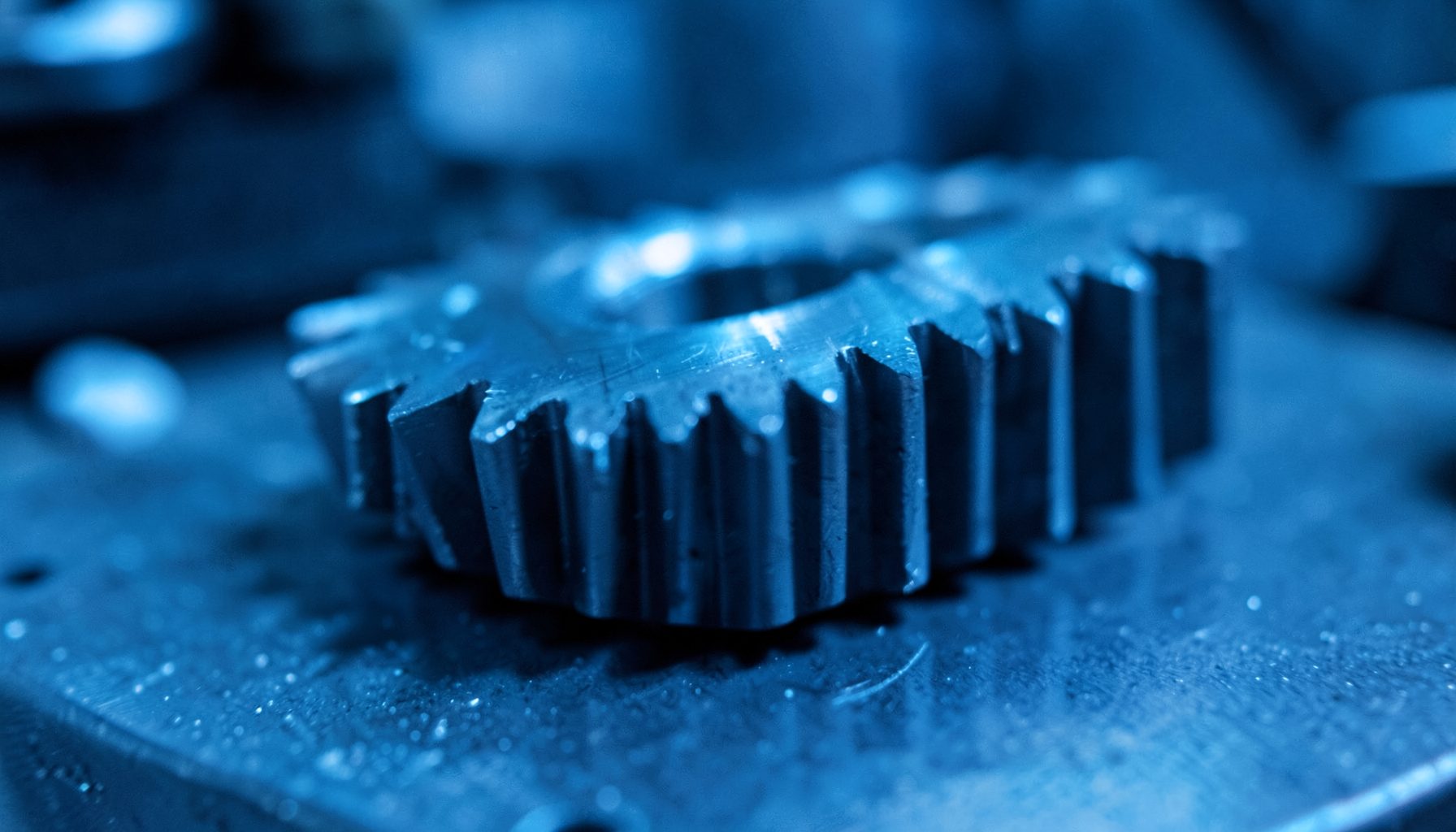
Once the oil film becomes marginal, the actual metal surface begins to control the wear rate. Microscopic high points can weld and tear apart, creating adhesive wear and localised scuffing. Repeated contact can also produce micropitting, where small fatigue cracks form near the surface and remove tiny fragments of material. The OPTIMIZE Project examines the wider design problem by connecting gearbox efficiency, durability, tolerances, simulation and physical testing.
Temperature is a major accelerator. A gearbox running hot near Darwin or during a high-power climb can oxidise lubricant more quickly than the same unit in a cooler cruise profile. High temperature also reduces viscosity at the point where the teeth need film support. This thermal feedback can become self-reinforcing: increased friction creates heat, reduced film thickness raises friction, and the contact becomes increasingly vulnerable.
Oxidation, Deposits and Additive Depletion
Oxidation begins when lubricant molecules react with oxygen under heat, pressure and catalytic contact with metal surfaces. The result can include acids, varnish, sludge and other insoluble products. These materials may restrict small oil passages, interfere with valve operation or settle on gear and bearing surfaces. In a tightly packaged aerospace gearbox, even modest deposits can affect oil delivery and cooling.
Additives provide much of the lubricant’s protection under difficult conditions. Extreme-pressure and anti-wear additives react with surfaces to create sacrificial films, while antioxidants slow the chemical breakdown of the base oil. With extended service, these additives can be consumed, depleted or altered. A laboratory result showing acceptable viscosity therefore does not necessarily prove that the oil still has its original wear-control capability.
Acidic oxidation products can attack protective surface layers and encourage corrosive wear. Corrosion pits then act as stress raisers during subsequent tooth engagements. In carburised gears, the damage may start below or near the hardened case and grow through repeated cyclic loading. This is why an apparently smooth tooth can still be developing a fatigue problem before visible material loss becomes obvious.
Oil ageing also changes how contamination behaves. Oxidised products can hold fine particles in suspension, while deposits may release suddenly when operating conditions change. Those particles pass through the mesh and create three-body abrasion, cutting shallow grooves into tooth flanks. Abrasive marks increase surface roughness, and rougher surfaces make it harder to sustain a continuous lubricant film.
Flight Hours, Duty Cycles and Australian Operating Conditions
Calendar age alone is a poor measure of lubricant life. Flight hours, power levels, start-stop events, temperature peaks and time spent at different speeds all influence degradation. A gearbox used on long sectors may spend many hours at a stable temperature, while a regional aircraft or utility platform may experience frequent thermal cycling, repeated climbs and high-power transitions.
Australian operations add useful examples of this variation. Aircraft flying from Perth to remote Western Australian locations may face dust exposure during ground handling and unsealed-airstrip operations. High airborne dust does not automatically enter the gearbox, but poor servicing practices, damaged breathers or contaminated oil containers can introduce abrasive particles. The same concern applies to aircraft supporting mining, medical and regional transport routes.
Humidity and salt are relevant around coastal cities such as Sydney, Brisbane and Cairns. Moisture entering through breathers, seals or condensation can promote rust and strip protective additives. In tropical Queensland, heat and humidity can combine with infrequent use to create a different risk profile from an aircraft flying consistently in dry inland conditions.
Australian operators also work within a regulated maintenance environment shaped by CASA requirements, approved data and documented airworthiness procedures. Oil sampling must therefore support traceable decision-making rather than informal judgments based on colour or smell. A maintenance team may describe an oil as “looking crook”, but reliable action depends on measured viscosity, particle concentration, water content, acid number, oxidation indicators and wear-metal trends.
Detecting Wear Before Tooth Damage Escalates
A practical condition-monitoring programme combines oil analysis with gearbox operating data and physical inspection. Spectrometric analysis can identify dissolved iron, nickel, chromium and other wear metals, although large particles may not appear in the same way. Ferrous debris monitoring, filter inspection and magnetic chip detection can reveal a developing problem that a basic laboratory sample misses.
Trend analysis is more useful than a single pass-or-fail result. A gradual rise in iron may reflect normal running-in, while a sudden increase after thousands of stable hours deserves investigation. The maintenance record should relate oil results to flight hours, oil changes, filter replacements, temperature excursions and any unusual vibration or noise.
Viscosity, total acid number, water content, particle count and oxidation measurements provide complementary evidence. Fourier-transform infrared analysis can help identify oxidation and additive depletion, while ferrography can show the size and shape of wear debris. No individual test explains every failure mode, so the best programme uses several indicators and compares them with known gearbox behaviour.
Physical inspection remains essential when trends deteriorate. Borescopes can identify scoring, pitting, discolouration and deposit formation without complete disassembly. Vibration monitoring may detect changes in mesh stiffness or bearing condition, though interpretation must account for load and speed. When a component is removed, metallurgical examination can distinguish fatigue, scuffing, abrasion and corrosion, preventing an oil-related symptom from being mistaken for the original cause.
Design Measures That Limit Wear Progression
Lubricant durability begins with gearbox design. Oil flow must reach the most highly loaded contacts without excessive churning, and the cooling system must keep bulk and local temperatures within the oil’s capability. Spray jets, scavenge arrangements, sump geometry and filtration all influence whether the lubricant remains clean and thermally stable.
Gear geometry also affects sensitivity to oil degradation. Surface finish, tooth modifications, contact ratio, alignment and load distribution determine how much pressure is concentrated at local asperities. Edge rounding can reduce sharp contact transitions and lower the likelihood that a small geometric imperfection will initiate a crack. Research on gear tooth edge rounding shows why small manufacturing and design details can influence long-term surface durability.
Tolerance analysis is particularly important in a hyperstatic gearbox, where several supports or gear meshes may share load in a way that is sensitive to manufacturing variation. Small changes in alignment, bearing stiffness or housing distortion can concentrate force on part of a tooth. If the oil film has already weakened through degradation, that local overload can accelerate micropitting or scuffing much faster than a nominal design calculation predicts.
Design-of-experiments methods help engineers separate the effects of oil temperature, viscosity, contamination, surface treatment and geometric variation. Simulation can identify vulnerable operating points, while rig testing can reproduce realistic speed, torque and thermal cycles. The resulting evidence supports more defensible oil-change intervals and may show that a modest design change provides greater wear resistance than simply specifying a more expensive lubricant.
Maintenance Decisions Over Extended Service
Oil replacement should be based on the approved maintenance programme and evidence from service experience, rather than an arbitrary universal hour limit. A gearbox that operates near its thermal boundary may require a different monitoring strategy from one with generous cooling capacity. Oil type, storage conditions, top-up practices and filter performance also affect how quickly protection is lost.
Sampling technique matters. Samples should be taken from a consistent, representative location while the oil is properly mixed, using clean equipment and documented timing. A sample drawn after a long settling period may understate circulating debris; a dirty bottle may create a false alarm. Keeping samples linked to aircraft registration, gearbox serial number and flight hours creates a reliable history for trend interpretation.
When degradation is confirmed, replacing the oil is only the first step. Engineers should look for the source of heat, contamination or additive depletion. Possible causes include an obstructed cooler, a failing seal, poor breather performance, incorrect oil specification, filter bypass or an emerging bearing problem. Simply installing fresh oil can temporarily improve test results while leaving the initiating fault in place.
Clear records are especially valuable in Australia’s distributed aviation market, where aircraft may move between major maintenance bases and smaller regional facilities. A gearbox serviced in Melbourne may later operate through Townsville or Broome, and its oil history needs to travel with the component. Consistent terminology, retained laboratory reports and prompt escalation of abnormal trends help keep decisions fair dinkum and technically defensible across different teams.
Technical communication should be just as disciplined when test imagery, videos or maintenance material are shared externally. Copyright ownership and watermarking matter when project evidence is republished; guidance on content protection practices can help teams avoid confusing an informal copy with an approved engineering record.
Monitoring oil condition is one of the most practical ways to control gear wear over extended flight hours. Combine laboratory oil analysis with temperature history, debris monitoring, vibration data and targeted inspection, then use the results to refine both maintenance intervals and gearbox design. Explore the OPTIMIZE research material, compare its testing and simulation approach with your own reliability process, and turn lubricant trends into earlier, evidence-based maintenance action.