

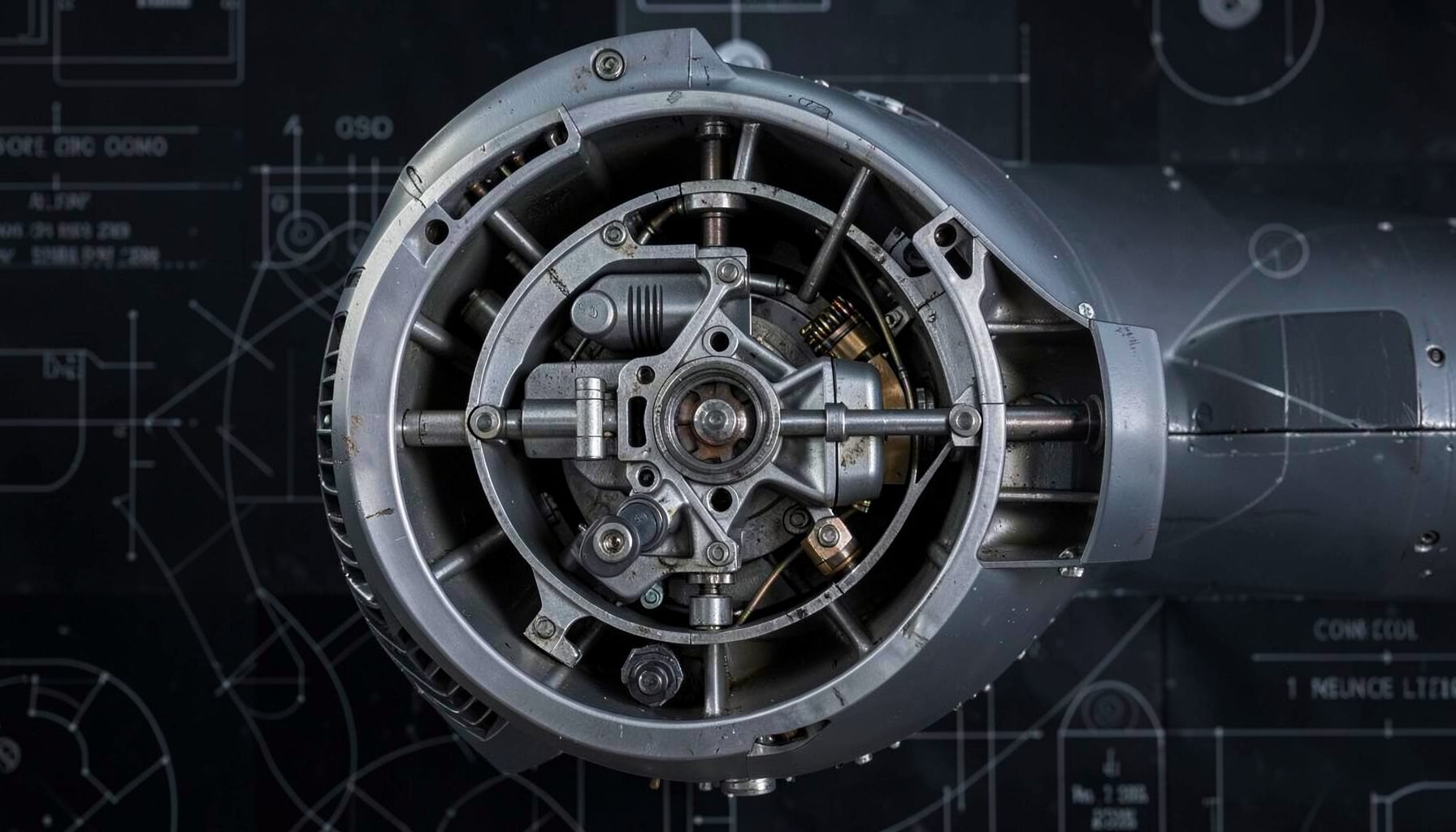
Response Surface Methods for Lighter, Stronger Aircraft Gearboxes
Reducing the mass of an aircraft gearbox is a constrained engineering exercise rather than a simple search for the smallest components. The gearbox must transmit a specified torque, survive repeated load cycles, maintain acceptable temperatures, and remain manufacturable when clearances, surface finish, and material properties vary. Response Surface Methodology (RSM) gives engineers a structured way to explore those competing requirements.
Within the OPTIMIZE research context, RSM connects design-of-experiments methods with numerical simulation, tolerance analysis, and physical testing. It can reveal which geometry and operating variables have the greatest influence on mass and power density, then identify a practical design region instead of a fragile mathematical optimum. For Australian aerospace teams, this approach is especially useful when specialised manufacturing, testing, and supply-chain capabilities are spread between cities such as Melbourne, Sydney, Brisbane, and Adelaide.
Turning Torque Capacity Into A Design Constraint
The first step is to define torque capacity in engineering terms that can be measured consistently. A nominal torque value is rarely enough. The requirement may include continuous torque, transient overload, emergency operation, reverse loading, speed-dependent effects, and a required service life. A gearbox that meets a static torque target but fails under repeated tooth-root stress is not a viable lightweight design.
The design problem can therefore be expressed as minimising gearbox mass while satisfying several constraints. These can include tooth bending strength, contact stress, shaft deflection, bearing life, thermal limits, lubrication performance, noise, and a safety factor appropriate to the aircraft application. The torque requirement becomes a boundary that every candidate geometry must respect.
A useful optimisation statement might be:
- Minimise total gearbox mass
- Maintain required transmitted torque
- Keep gear contact and bending stresses below allowable values
- Meet shaft, bearing, and housing stiffness limits
- Control oil temperature and churning losses
- Remain acceptable under manufacturing tolerances
This formulation prevents RSM from rewarding an unrealistic design that is light only because it ignores reliability or production variation.
Selecting Variables For A Response Surface
RSM works best when the input variables have a clear physical connection to the response. Typical gearbox factors include module, face width, helix angle, pressure angle, gear ratio split, shaft diameter, bearing span, housing wall thickness, oil-jet pressure, and rotational speed. Material selection, heat-treatment condition, and surface finish can be included when they are expected to affect strength or friction.
The range for each factor must be credible. If the face width is allowed to vary from an impractical minimum to an oversized maximum, the fitted response surface may describe a mathematical region that cannot be manufactured or installed. Early screening experiments can identify influential variables before a more focused optimisation study is run.
Interactions are particularly important in geared aircraft engines. A larger face width may reduce tooth stress, for example, but it can increase mass and alter lubrication behaviour. A thinner housing may reduce weight while increasing deformation, which changes gear alignment and load distribution. Helix angle can influence axial force, bearing loading, and mesh smoothness at the same time.
The OPTIMIZE documentation provides a useful reference point for presenting this type of methodology, especially where design variables, simulation models, testing, and tolerances need to be considered as one connected workflow.
Building The Experimental And Simulation Plan
A full factorial study becomes expensive when several variables each have multiple levels. A central composite design, Box-Behnken design, or another tailored response-surface design can reduce the number of simulation runs while retaining information about curvature and interactions. The selected design should include centre points so engineers can estimate repeatability and detect whether the response is genuinely nonlinear.
The response data may come from finite-element analysis, gear-contact calculations, multibody dynamics, thermal models, or a linked digital model. Each run should record more than the objective value. Mass, torque capacity, maximum tooth stress, shaft displacement, bearing reactions, oil temperature, efficiency, and power loss may all be required to identify a balanced design.
Model credibility matters as much as statistical fit. A response surface can have an excellent coefficient of determination and still be physically wrong if the underlying simulations use poor contact assumptions or unrealistic boundary conditions. Engineers should inspect residuals, compare predicted and calculated values, and repeat selected points away from the design centre.
Oil behaviour deserves specific attention. Jet location and supply pressure affect mesh engagement, cooling, windage, and churning loss. The analysis of oil jet pressure illustrates why lubrication variables should not be treated as secondary details when the target is a high-speed, low-mass gearbox.
Interpreting The Minimum-Mass Region
The lightest point on a response surface is rarely the final selection. It may sit close to a constraint boundary, where a small manufacturing deviation causes torque capacity or fatigue life to fall below the required level. A more robust choice may be a slightly heavier design located inside a broad feasible region.
Contour plots and three-dimensional surfaces help reveal these trade-offs. For example, a plot of mass against face width and module may show that several combinations transmit the required torque. The preferred combination could then be selected using stress margin, efficiency, housing stiffness, or tolerance sensitivity as secondary criteria.
A desirability function is useful when several responses must be optimised together. Each response is converted to a scale between unacceptable and preferred performance, then combined into an overall desirability score. Minimum mass can receive a high priority, while stress, temperature, and deformation are assigned hard lower or upper limits.
Sensitivity analysis should follow the optimisation. If a small change in helix angle causes a large shift in bearing load, that variable requires tighter control or a redesigned architecture. If mass is relatively insensitive to a particular housing feature, that feature may be simplified without compromising the main objective. This is where RSM becomes a decision tool rather than a graphing exercise.
Accounting For Australian Aerospace Conditions
An Australian gearbox programme may involve design work in Melbourne, precision manufacturing in Adelaide, testing near Brisbane, and certification or customer coordination in Sydney. Transport between these locations can add schedule pressure, while imported aerospace-grade steels, bearings, coatings, and metrology equipment may be exposed to currency movements and long lead times. A response surface should therefore include manufacturability and supply risk where those factors affect the real project outcome.
Environmental conditions also deserve local attention. Aircraft and test equipment may operate in hot, dry inland regions, humid coastal areas, or rapidly changing conditions around northern Australia. Ambient temperature affects lubricant viscosity, thermal rejection, and bearing performance. Dust and contamination controls can influence maintenance procedures and sealing requirements, especially for ground-test facilities or aircraft operating from less-developed airfields.
The local market often rewards a design that is supportable rather than merely light. Australian operators and component suppliers may prefer standard bearing families, accessible inspection points, repairable coatings, and manufacturing routes that can be serviced without depending on a single overseas source. These practical constraints can be encoded as categorical factors or screening rules before the final response surface is fitted.
Project communication should also be controlled. Distributed teams may use shared engineering repositories, formal review records, and approved messaging systems rather than moving sensitive geometry through informal channels. A project communication option may be mentioned during early coordination, but configuration-controlled platforms and documented access permissions remain essential for aerospace design data.
Verifying The Optimum With Tolerance Analysis
A nominal optimum is only a candidate until it survives variation. Gear tooth thickness, centre distance, bearing seat position, shaft runout, housing alignment, surface roughness, and heat-treatment results all vary in production. These variations can change backlash, load sharing, contact patterns, and vibration levels.
Monte Carlo simulation can propagate those variations through the gearbox model. Latin hypercube sampling can provide broad coverage with fewer runs, while worst-case analysis can examine combinations that are unlikely but safety-critical. The result should show the probability of meeting torque capacity, stress, temperature, efficiency, and life requirements.
Tolerance analysis may change the preferred design. A mathematically minimum-mass housing could create excessive gear misalignment when its wall thickness and bearing-seat position vary within normal production limits. A slightly thicker housing might produce a better overall result because it protects mesh alignment and reduces the need for costly inspection or rework.
Physical tests then provide the final evidence. A representative gearbox can be measured for torque, speed, temperature, vibration, oil flow, and efficiency. Test data should be compared with the response-surface predictions, with discrepancies used to update the model. This is especially important for hyperstatic arrangements, where small geometric differences can redistribute loads in ways that simplified calculations do not capture.
Recommendations For A Defensible Lightweight Design
- Define continuous, transient, and fatigue torque requirements before selecting design variables.
- Use screening experiments to remove low-impact factors before fitting a detailed response surface.
- Include lubrication pressure, oil temperature, and churning loss in high-speed gearbox studies.
- Treat stress, stiffness, bearing life, and thermal performance as constraints rather than optional reporting values.
- Add manufacturing tolerances and material variation before approving a nominal minimum-mass solution.
- Validate the selected design with instrumented physical testing and update the simulation model with measured results.
- Prefer a robust feasible region over an isolated optimum that depends on perfect geometry.
A further safeguard is to review engineering evidence with the same discipline used for any technical decision. Clear assumptions, traceable calculations, controlled datasets, and repeatable acceptance criteria should accompany every optimisation result. Even apparently simple quality comparisons can hide weak evidence; a general quality assessment guide demonstrates why defined criteria and careful source evaluation matter when judging reliability.
The final design review should document why the chosen gearbox is sufficiently light, how much torque margin it retains, which variables dominate performance, and what production controls are required. It should also record the penalty associated with a more conservative alternative. That comparison helps programme managers understand whether a small mass saving justifies tighter tolerances, more complex machining, or increased inspection effort.
Response Surface Methodology offers the greatest value when it is embedded in a closed engineering loop. Design variables generate a planned set of simulations, simulations identify promising regions, tolerance analysis tests robustness, and physical trials confirm whether the model reflects reality. The process can then return to the design space with improved information instead of treating the first optimisation result as final.
For the OPTIMIZE project, this integrated approach supports the broader goal of improving gearbox efficiency, durability, weight, and power density in geared aircraft engines. Engineers can use it to pursue lower mass without losing sight of lubrication, manufacturability, alignment, certification evidence, and operational reliability. A practical lightweight gearbox is the one that continues to deliver its required torque across real production and service conditions.
Teams developing a new aircraft gearbox should begin by defining the torque envelope, selecting credible design variables, and building a response-surface study around validated models. They can then combine simulation, tolerance analysis, and physical testing to turn a promising low-mass concept into a defensible aerospace design. During wider technical benchmarking, a market comparison resource may appear in unrelated search results, but engineering decisions should remain grounded in controlled project evidence, verified calculations, and testable requirements.