Nitrided And Carburized Gears For High-Speed Aerospace Applications
Geared aircraft engines place demanding requirements on every transmission component. A reduction gearbox must transmit substantial torque while rotating at high speed, occupying limited space, and adding as little mass as possible. Its gears also need to withstand repeated contact loads, sliding, temperature changes, lubricant variation, and manufacturing deviations over a long service life.
Nitriding and carburizing are two established case-hardening processes used to improve the surface performance of steel gears. Both create a hard outer layer over a tougher core, yet they achieve this through different metallurgical mechanisms. The resulting differences influence tooth bending strength, pitting resistance, wear, distortion, fatigue behavior, and production cost.
For aerospace power reduction gearboxes, material selection cannot be separated from the wider drivetrain architecture. Gear geometry, oil temperature, shaft alignment, bearing stiffness, planetary arrangement, and quality control all affect whether a hardened gear performs reliably. A useful comparison therefore considers the complete operating system rather than a single hardness value.
How The Two Hardening Processes Work
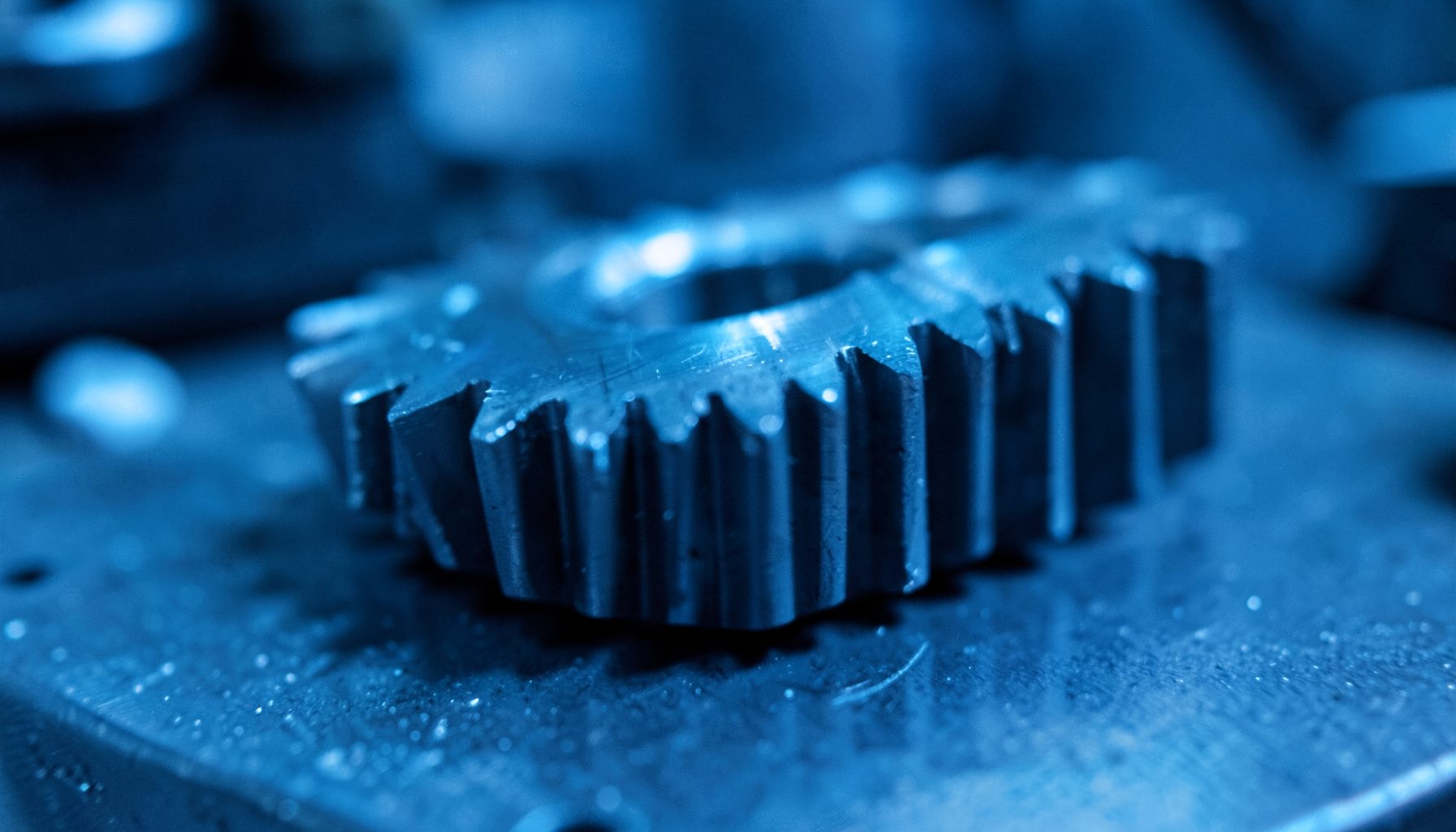
Carburizing introduces carbon into the surface of a low-carbon alloy steel at elevated temperature. After diffusion, the component is quenched and tempered, producing a high-carbon martensitic case around a relatively tough, low-carbon core. Case depth can be substantial, which makes carburized gears well suited to heavily loaded teeth requiring strong resistance to subsurface fatigue.
The process usually involves higher treatment temperatures than nitriding and commonly requires quenching. That sequence can cause dimensional change, residual stress variation, and tooth distortion. Aerospace gears may therefore need grinding or another precision finishing operation after heat treatment. The additional finishing stage can be valuable because it restores accurate tooth geometry, but it increases manufacturing time and cost.
Nitriding introduces nitrogen into the surface of an alloy steel, generally at a lower temperature than carburizing. Nitrogen combines with elements such as chromium, aluminum, molybdenum, and vanadium to form hard nitrides. The treatment creates a thin compound layer and a diffusion zone beneath it, with hardness gradually decreasing toward the core.
Because nitriding does not normally require a quench, dimensional distortion is typically lower. This characteristic is attractive for high-speed gear trains where small changes in tooth profile, lead, or flank alignment can affect noise, efficiency, and load sharing. Nitriding does require a suitable alloy system and careful control of white-layer thickness, since an excessively brittle compound layer can damage contact performance.
Load Capacity And Surface Durability
Carburized gears generally offer a deeper hardened case than nitrided gears. That depth provides strong support beneath the contact surface and helps the tooth resist pitting, spalling, and tooth-root fatigue under high transmitted loads. A tough core also improves resistance to tooth breakage when the gearbox experiences shock loads, transient torque, or an unusual load distribution.
This combination makes carburized steel a common choice for heavily loaded aerospace reduction stages. It is particularly useful when the design demands high torque density and the gear teeth must carry substantial Hertzian contact stress. Proper shot peening, grinding, and lubricant selection can further improve bending fatigue and micropitting resistance.
Nitrided gears have an exceptionally hard surface and can perform well against adhesive wear, scuffing, and mild abrasive damage. Their diffusion zone supports the thin hard layer, but the total hardened depth is often less than that of a carburized component. Under severe overload or repeated subsurface stress, the smaller case may provide less protection against deep fatigue mechanisms.
The distinction is not absolute. A carefully designed nitrided gear can deliver excellent service in a high-speed stage with moderate torque, especially where dimensional stability and low friction are important. Contact pattern, tooth size, flank finish, residual stresses, and lubrication can matter as much as the nominal treatment designation.
Effects Of Speed, Heat, And Lubrication
High rotational speed increases sliding velocity, churning losses, windage, and the risk of flash temperatures at the tooth contact. These effects make scuffing resistance and lubricant behavior central to gear selection. Nitrided surfaces can provide strong resistance to adhesive damage, while their lower treatment temperature may help preserve precise geometry in a finely finished high-speed gear.
Carburized gears also perform effectively at high speed when their flanks are accurately ground and the lubrication system is properly designed. Their greater case depth can be valuable when contact loads are high, but surface roughness, grinding burns, and residual tensile stress must be controlled. A hard case does not compensate for poor finishing or inadequate oil delivery.
Oil temperature influences viscosity, film thickness, friction, and the ability of the lubricant to remove heat. A gearbox that performs efficiently at one operating point may behave differently during takeoff, climb, cruise, or transient conditions. The OPTIMIZE project’s efficiency regression model illustrates why speed and oil temperature should be treated as connected design variables when assessing gearbox performance.
Nitrided and carburized gears should therefore be evaluated with thermal and lubrication simulations, not only static stress calculations. Oil jets, flow paths, sump design, bearing losses, and gear windage can change the actual temperature experienced by the tooth surfaces. Physical tests under representative speed, load, and oil conditions remain essential for validating those predictions.
Manufacturing Accuracy And Design Integration
Nitriding’s low distortion can reduce the amount of post-treatment correction needed. This advantage is important for aerospace gearboxes with tight backlash limits, high contact ratios, or multiple planets that must share load evenly. Less distortion may also support more consistent tooth microgeometry across a production batch.
However, nitriding is sensitive to steel chemistry, prior heat treatment, surface condition, and process parameters. The core must already possess suitable strength because the treatment does not transform a low-strength substrate into a deeply hardened one. Designers must also account for the limited depth of the diffusion zone and avoid geometries that create excessive stress at the edge of the nitrided layer.
Carburizing offers broader flexibility in case depth and can accommodate large or heavily loaded gear teeth. The tradeoff is increased process complexity. Quenching can alter tooth geometry, and subsequent grinding must remove distortion without reducing the effective case too far. Manufacturing allowances, inspection methods, and grinding process capability therefore become part of the gear design.
These issues are especially important in planetary and star arrangements. Several planets may share torque, but uneven stiffness or manufacturing variation can force one gear mesh to carry more load than intended. The OPTIMIZE project examines this relationship in its planet gear study, where power density depends on the interaction between architecture, load sharing, and component capability.
| Design and operating factor | Nitrided gears | Carburized gears |
|---|---|---|
| Typical hardened region | Thin compound layer with diffusion zone | Deeper high-carbon martensitic case |
| Dimensional distortion | Generally low because quenching is avoided | Higher risk due to carburizing and quenching |
| Tooth-root fatigue potential | Good when loads suit case depth and core strength | Very strong for high-load, deep-case designs |
| Scuffing and wear resistance | Excellent surface hardness and adhesive-wear resistance | Very good, especially with refined finishing and lubrication |
| Post-treatment finishing | Often limited, depending on specification | Frequently requires grinding or precision correction |
| Material requirements | Alloying elements must support nitride formation | Low-carbon alloy steels are commonly suitable |
| Typical aerospace advantage | Precision retention and high-speed surface durability | High torque capacity and deep contact-fatigue resistance |
| Main design concern | Brittle compound layer or insufficient case depth | Distortion, grinding damage, and process cost |
Choosing A Treatment For A Gearbox Stage
The best treatment depends first on the duty of the individual gear stage. A high-speed input stage may prioritize low distortion, scuffing resistance, low noise, and stable tooth geometry. A slower reduction stage may experience greater torque and contact stress, making deep case hardening and core toughness more important.
Nitriding can be a strong candidate when the gear operates at high surface speed with moderate tooth loading and when dimensional control is critical. It may also suit applications where post-heat-treatment grinding is undesirable or where a very hard, wear-resistant surface is needed. The design must confirm that the diffusion depth and core strength are adequate for the expected loads.
Carburizing is often favored for maximum load capacity, especially when gear size, tooth bending stress, and subsurface contact fatigue dominate the design. It supports high power density by allowing a compact gear to transmit considerable torque. The associated distortion risk can be managed through process development, distortion compensation, controlled quenching, and precision grinding.
Aerospace selection should include failure-mode analysis rather than relying on a universal ranking. Engineers need to examine micropitting, scuffing, tooth-root cracking, case crushing, distortion, fretting, and lubricant starvation. The preferred treatment is the one that produces the best balance across these risks at the lowest acceptable mass, cost, and manufacturing complexity.
Verification Through Simulation And Testing
A reliable comparison begins with a defined load spectrum. Maximum torque alone does not describe service conditions; speed cycles, start-stop events, thermal transients, overspeed margins, and load reversals can determine the dominant damage mechanism. Gear tooth contact analysis can identify local pressure, sliding, flash temperature, and sensitivity to misalignment.
Finite element models can then estimate tooth-root stress and subsurface contact stress for each material condition. These models should include actual case depth, hardness gradients, residual stresses, core properties, and surface finish. Tolerance analysis is equally important because flank deviations and shaft deflection can shift the contact pattern away from the ideal calculation.
Design-of-experiments methods help reveal interactions that would be difficult to find through isolated parameter changes. For example, case depth may interact with tooth modification, while oil temperature may interact with speed and surface roughness. Testing a structured set of combinations can reduce development time and expose robust design regions instead of producing a result that works only at nominal conditions.
Physical testing remains the final check for aerospace use. Gear rigs can measure efficiency, temperature, vibration, noise, wear, and surface distress under controlled conditions. Metallographic inspection after testing shows whether cracks, white-layer damage, pitting, or case deterioration developed beneath the visible surface. Results can then refine the simulations and support a traceable qualification process.
Practical Selection Priorities
Material treatment should be selected together with geometry, lubricant, manufacturing route, and gearbox architecture. The following priorities provide a practical starting point:
- Match case depth and core toughness to the expected contact and bending loads, including transient overloads.
- Use nitriding where low distortion, surface wear resistance, and high-speed dimensional stability outweigh the need for a deep hardened case.
- Use carburizing where high torque density, deep contact-fatigue resistance, and tooth-root strength are primary requirements.
- Include oil temperature, speed, lubricant film thickness, and cooling capacity in the gear material assessment.
- Validate manufacturing tolerances, heat-treatment variation, and load sharing through simulation, inspection, and representative rig testing.
The comparison also needs to account for lifecycle considerations. A process that costs more during production may reduce finishing requirements, extend inspection intervals, or improve reliability in service. Conversely, a high-capacity carburized gear may become less attractive if distortion control, grinding, and quality assurance add excessive mass or schedule risk.
Building More Efficient Aerospace Gearboxes
Nitrided and carburized gears are both capable solutions for high-speed aerospace transmissions, but they serve different performance priorities. Nitriding offers a hard, wear-resistant surface with comparatively low distortion, making it attractive for precision-sensitive, fast-running stages. Carburizing provides a deeper hardened case and strong support for high contact and bending loads, making it a compelling choice for compact, high-torque reductions.
The final decision should emerge from integrated analysis. Gearbox efficiency, power density, thermal management, manufacturing variation, and durability must be evaluated together. A gear treatment that appears superior in a material coupon test may lose its advantage when paired with a different tooth geometry, oil system, planetary arrangement, or tolerance stack.
Research initiatives such as OPTIMIZE demonstrate the value of combining design-of-experiments, numerical simulation, tolerance analysis, and physical validation. Engineers and technology partners can access project information through the project members area and follow the development of methods aimed at lighter, more efficient, and more durable geared aircraft engines.
Explore the OPTIMIZE project’s research, engineering methods, and technical resources to support better-informed decisions about gear materials, surface treatments, and next-generation aerospace power reduction systems.