

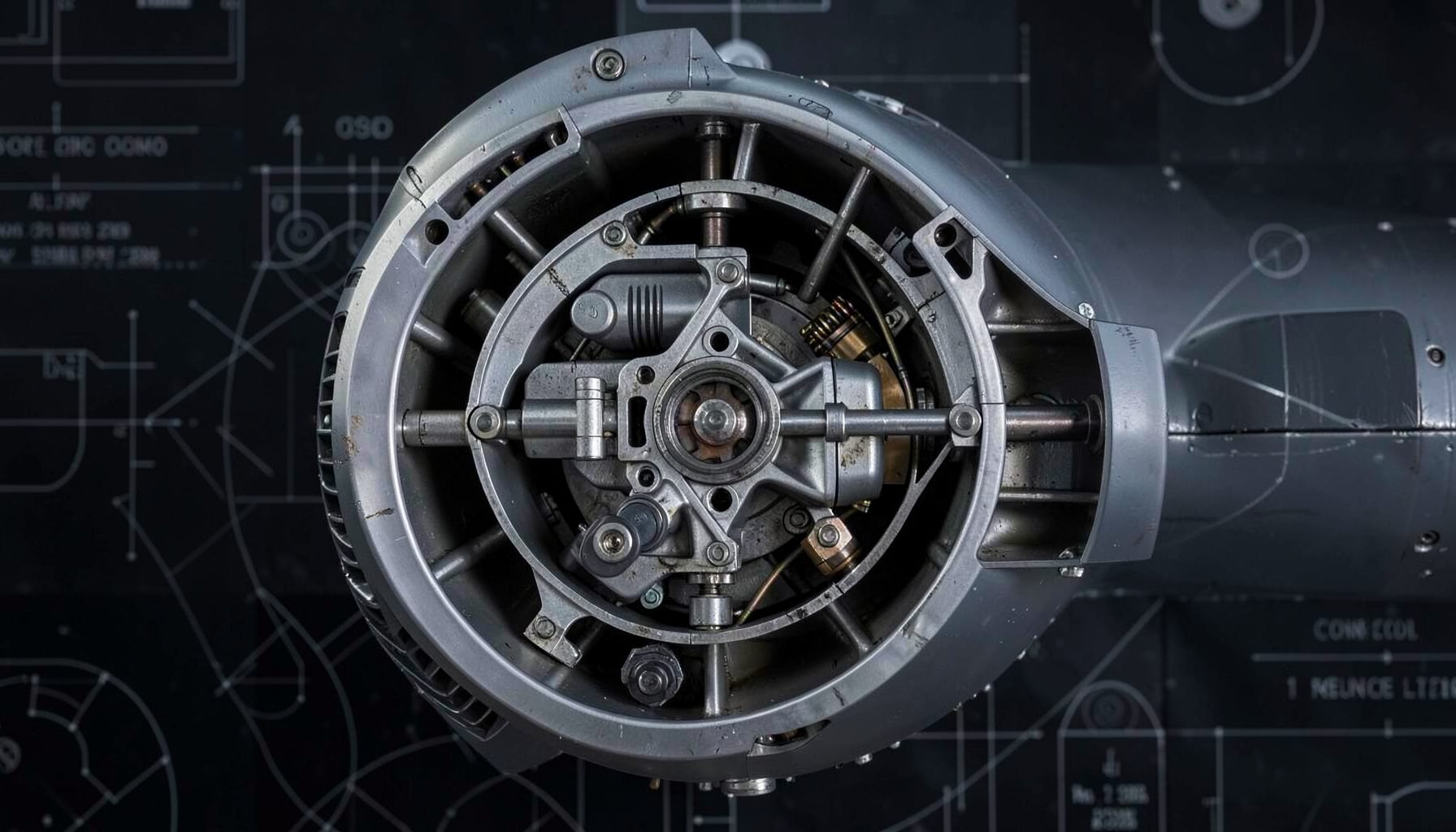
Response Surface Methods for Efficient, High-Density Gearboxes
Geared aircraft engines promise useful gains in propulsive efficiency, especially when a reduction gearbox allows the turbine and propeller to operate at more suitable speeds. The gearbox then becomes a compact, highly loaded system in which tooth geometry, bearings, shafts, lubrication, housing stiffness and manufacturing tolerances all interact. Small changes in one parameter can alter several performance measures at once.
Response Surface Methodology (RSM) gives engineers a structured way to investigate those interactions. Instead of testing every possible combination, a designed set of simulations or experiments can reveal curvature, interactions and practical operating regions. For the OPTIMIZE project, this approach supports the search for lower losses, higher power density and adequate durability without treating efficiency as an isolated target.
Why Power Density Needs A System View
Power density is commonly expressed as transmitted power divided by gearbox mass or volume. Increasing it may involve smaller gears, a higher rotational speed, a reduced housing envelope or more aggressive material utilisation. Each choice can increase tooth stress, bearing loads, thermal demand or sensitivity to production variation. A solution that looks excellent in a nominal computer model may therefore be unsuitable once clearances, surface finish and assembly conditions are included.
Efficiency has a similarly broad definition. Mesh losses arise from sliding and rolling contact, while churning, seal drag, bearing friction and oil pumping add parasitic losses. At high speed, lubricant behaviour becomes especially important. A reduction in oil quantity might lower churning power, yet it could also reduce cooling capacity or leave a heavily loaded tooth contact vulnerable to scuffing.
The operating environment matters as well. An aircraft flying from Brisbane in hot, humid conditions can impose a different thermal burden from one departing Hobart on a cool morning. Remote Australian operations may also place a premium on low maintenance and predictable inspection intervals because specialist support is not always close by. These realities should be represented through boundary conditions and constraints rather than left to a final qualitative review.
Selecting Variables For A Useful Design Space
The first RSM task is to identify controllable factors with a credible physical connection to gearbox performance. Candidate variables may include normal module, helix angle, face width, tooth count, gear ratio, centre distance, shaft diameter, bearing preload, oil flow, lubricant viscosity and housing wall thickness. Manufacturing variables such as profile modification, flank waviness, backlash and alignment error can be added when tolerance sensitivity is part of the study.
A fractional factorial design or central composite design can screen the variables efficiently. Screening identifies the factors that deserve detailed modelling, while the later response surface estimates how important factors interact. For example, face width may improve load capacity until housing deflection causes misalignment, while a larger helix angle may increase overlap ratio and load sharing at the cost of greater axial bearing load.
Gear geometry should be interpreted through the underlying mechanics. The relationship between gear contact ratio and tooth bending stress is relevant when deciding whether a geometric change genuinely improves durability or simply shifts the load elsewhere. This prevents the statistical model from becoming a black box detached from gear theory.
Constructing Reliable Response Surfaces
Each design point should generate responses from appropriate analysis tools. A meshing model can estimate contact stress, sliding losses and load distribution. A shaft and bearing model can calculate reactions, deflection and misalignment. Computational fluid dynamics or validated lubrication correlations can estimate oil temperature, churning losses and flow behaviour. Finite-element analysis is valuable for housing stiffness and local stress concentrations.
The quality of an RSM model depends on the quality of these inputs. A coarse mesh, unrealistic boundary condition or simplified bearing stiffness may create a smooth response surface that is numerically convincing but physically wrong. Engineers should record model assumptions, convergence results and the range over which each response is valid. A quadratic surface is useful inside the design region; it should not be treated as a reliable predictor far outside it.
Validation points are essential. Several combinations should be held back from model fitting and evaluated later through high-fidelity simulation or physical testing. If predicted and observed results disagree, the team can add interaction terms, transform the response, refine the design region or reconsider the original physical model. External technical references can support broader engineering checks; an engineering reference source may be useful during general background research, provided its technical claims are independently verified.
Balancing Efficiency, Mass And Durability
Gearbox optimisation is a multi-objective problem. A design that minimises mass may increase temperature, tooth stress or vibration. A highly efficient gear mesh may require tighter manufacturing control, premium coatings or more complex lubrication hardware. RSM helps expose this trade-off through desirability functions, Pareto frontiers or weighted objective functions.
A typical combined objective might maximise power density and mesh efficiency while minimising mass, peak temperature and predicted failure risk. Constraints could include allowable contact stress, bending stress, bearing life, oil temperature, shaft deflection, gear whine, manufacturing capability and safety factors. The weights should be agreed by the engineering and certification teams rather than selected solely because they produce an attractive optimum.
Surface engineering can expand the feasible region. Diamond-like carbon coatings, for example, may reduce friction and protect gear flanks under selected lubrication conditions. A review of the DLC coating study can inform candidate assumptions, but coating adhesion, substrate preparation, wear mechanisms and aerospace qualification still require direct evidence.
For Australian operators and manufacturers, the cost function can include supply-chain and service factors. A component available from Adelaide or Melbourne may be preferable to one dependent on long overseas lead times, even if its purchase price is slightly higher. Local repair capability, air freight exposure, GST treatment and access to qualified machinists can affect the practical value of a theoretical performance gain.
Including Tolerances And Physical Evidence
Nominal optimisation is only the first pass. A gearbox assembled with maximum shaft runout, unfavourable bearing clearance and an adverse tooth thickness combination may experience a much higher load concentration than the nominal design predicts. Monte Carlo simulation, Latin hypercube sampling or worst-case tolerance analysis can map this variation across the response surface.
Hyperstatic gear systems are particularly sensitive because multiple contacts can share load in ways that depend on deflection and manufacturing error. Housing distortion, bearing seating and thermal growth may change the alignment during operation. Tolerance analysis should therefore include dimensional variation, elastic deformation and temperature-dependent changes where those factors influence contact conditions.
Physical testing closes the loop. Component rigs can measure mesh power loss, temperature, vibration and wear, while full gearbox tests can examine endurance, transient response and lubrication behaviour. Test data should be used to calibrate friction coefficients, stiffness values and thermal models. The objective is not simply to confirm a preferred design, but to determine whether the response surface predicts reality within a useful engineering margin.
Certification planning should begin alongside optimisation. In Australia, aircraft and engine projects must align their evidence with the relevant Civil Aviation Safety Authority expectations and applicable airworthiness requirements. A design that is efficient but difficult to inspect, validate or document may create a larger programme risk than a slightly heavier alternative. Test instrumentation, traceable materials and configuration control make later approval work more manageable.
Applying The Method In An Australian Programme
An effective workflow begins with a clear design space, a small number of high-value responses and a defined validation strategy. Engineers can then run a screening DOE, remove weak factors, fit response surfaces and identify a set of promising candidates. Those candidates should undergo detailed thermal, structural, dynamic and manufacturing reviews before prototype manufacture.
The choice between simulation and testing should reflect the failure mode. Contact stress and load sharing may be explored economically through numerical models, while friction and lubricant churning often benefit from rig measurements. High-speed testing must account for containment, overspeed protection, instrumentation limits and safe disposal of failed components. These requirements are particularly important when a prototype is tested at an Australian aerospace facility with limited access to specialist replacement equipment.
Clear communication also matters outside the laboratory. Project videos and concise design explanations can help operators, suppliers and funding bodies understand why a design with a slightly higher mass may offer better reliability. Public-facing material should remain technically focused and avoid mixing propulsion claims with unrelated consumer content, such as articles about playing pokies at home. Separating those subjects protects the credibility of the engineering message and supports responsible communication in the Australian market.
Useful recommendations for applying RSM to a gearbox programme include:
- Define power density, efficiency, life and thermal limits before choosing optimisation weights.
- Include gear geometry, lubrication, bearings, housing stiffness and manufacturing tolerances in the factor list.
- Use physics-based simulation to generate responses, then validate selected points with rig testing.
- Treat contact ratio, load sharing and alignment as interacting variables rather than independent checks.
- Add Australian operating conditions, supply-chain constraints and CASA evidence needs to programme planning.
- Preserve model assumptions, test data and configuration history for repeatable design decisions.
| Engineering approach | Main strength | Typical limitation | Best use in gearbox development |
|---|---|---|---|
| Full-factorial testing | Shows all interactions in a small design space | Becomes expensive as factors increase | Early studies with two or three variables |
| Fractional factorial DOE | Screens many variables efficiently | May confound some interactions | Identifying influential design and process factors |
| Central composite RSM | Captures curvature and quadratic effects | Needs a sensible factor range | Refining an efficient operating region |
| High-fidelity simulation | Reveals local stress, thermal and flow behaviour | Requires time, computing and validated inputs | Checking shortlisted designs and failure risks |
| Monte Carlo tolerance analysis | Quantifies production and assembly variation | Depends on realistic distributions | Robustness and manufacturing capability assessment |
| Physical rig testing | Measures real losses, temperature and wear | Costly and slower than simulation | Correlation, endurance and qualification evidence |
A well-built response surface does more than identify a mathematical optimum. It shows which variables have leverage, where the design becomes fragile and how much performance is lost when manufacturing or operating conditions move away from nominal. That information can guide robust design, supplier specifications and test priorities.
Use Response Surface Methodology as a connected engineering process: define the objectives, model the physics, quantify variation, test the critical predictions and update the design with evidence. For geared aircraft engines, this disciplined path can turn competing demands for compactness, efficiency and durability into a defensible gearbox architecture ready for further development and qualification.